Headaches
That 'migraine' might actually be your neck crying for help
During a migraine, neck pain shows up more often than nausea, one of migraine's signature symptoms. Sometimes the neck is just along for the ride; sometimes it's the whole story, wearing a migraine's clothes. Here's how to tell which.

You feel it building behind one eye, so you do what you always do: dim the lights, swallow the tablets, write off the afternoon to another migraine. But rewind a few hours. Before the eye, before the queasiness, there was a tight, aching neck, the kind you stopped noticing years ago. What if that isn’t a coincidence? What if, at least some of the time, the thing you’ve been treating as a migraine is really your neck, waving a flag you taught yourself to ignore?
The clue almost everyone ignores
One finding should give you pause. When researchers tracked what people actually feel during a migraine attack, neck pain turned up more often than nausea (Calhoun et al., 2010). And nausea is one of migraine’s textbook, defining symptoms. The neck was there even more reliably, yet almost nobody thinks to mention it.
It’s not a fluke of one small study, either. In a general-population survey, one-year neck-pain prevalence was 85.7% among people with a primary headache disorder, versus 56.7% among people without one (Ashina et al., 2015). Wherever headaches go, the neck tends to tag along.
So the neck is at the scene of almost every headache. But is it an innocent bystander, or the culprit?
Your head and neck share one wiring closet
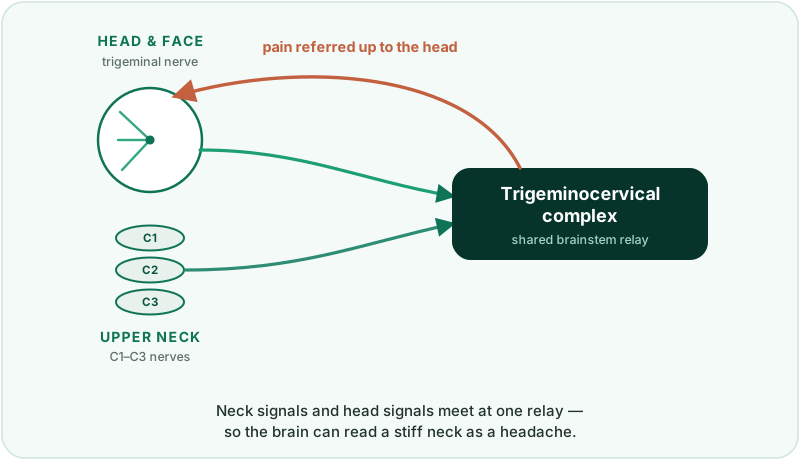
To see why the neck can masquerade as a headache, you have to look at the wiring. The top three nerves of your neck (C1 to C3) feed into the same brainstem relay station as the trigeminal nerve, the one that carries pain from your face, scalp, and the sensitive lining around your brain. Neuroscientists call this shared hub the trigeminocervical complex.
The catch: when signals from two different places arrive on the same wire, your brain can’t always tell them apart. A pain message coming up from an irritated neck joint can get read as coming from the head, and the ache gets “referred” upward into your skull, temple, or behind the eye.
This isn’t hand-waving. In the lab, irritating the brain’s lining made neck-input neurons fire harder (Bartsch & Goadsby, 2003), and stimulating a nerve at the back of the head cranked up sensitivity to head-pain input (Bartsch & Goadsby, 2002). In other words, it’s a two-way street: the neck can light up the head, and the head can light up the neck. That loop is a big part of why migraine and neck pain feed each other so relentlessly.
When it isn’t a migraine at all
Now the plot twist. Some headaches don’t merely involve the neck, they’re generated by it. The medical name is cervicogenic headache: a headache whose actual source is a structure in the neck, usually a joint, disc, or nerve in the upper spine, referring its pain into the head (Bogduk & Govind, 2009).
Around 2.5% of the general adult population have it (Nilsson, 1995). That sounds small until you run it across a whole city, and the share climbs steeply among people with frequent, chronic headaches.
The usual suspect is a small joint between your second and third neck vertebrae, served by the third occipital nerve. The proof is unusually clean: in people left with chronic headaches after a whiplash injury, numbing that one joint with a controlled anaesthetic block abolished the headache in about a quarter of them (Lord et al., 1994). Freeze one neck joint, the headache stops. Case closed.
And here’s the part that costs people years: cervicogenic headache is a champion impersonator. It gets routinely mislabelled as migraine or tension headache, so sufferers keep treating the wrong diagnosis while the real source, a few centimetres lower than anyone’s looking, goes untouched (Bogduk & Govind, 2009).
So how do you tell them apart?
Honestly? Only a clinician can confirm it, and the two genuinely overlap. But some features lean cervicogenic:
- The pain starts at the back of the head or neck and creeps forward, rather than pounding from the front.
- It’s side-locked, stubbornly the same side every time, and doesn’t swap sides.
- It’s provoked by the neck: certain head positions, sustained postures, or pressing on the neck can set it off or crank it up.
- Your neck feels stiff, with a noticeably reduced range of motion.
Classic migraine, by contrast, more often throbs, switches sides between attacks, drags along strong nausea or aura, and tends to run in the family.
One honest caveat: you can have both at once. And because of that shared wiring closet, treating the neck can still ease a genuine migraine, even when the neck isn’t the original cause.
The honest part: not every headache is your neck
Let’s keep this in proportion, because the internet loves a master key and this isn’t one. The neck is a genuinely under-recognised driver of headaches, not the explanation for all of them. Plenty of migraines are just migraines. The takeaway isn’t “it’s always your neck.” It’s “the neck is worth checking, and surprisingly often, it’s the piece nobody checked.”
When to see a doctor (please don’t skip this)
Some headaches are emergencies, so we’ll be blunt. Get urgent medical care if you have a sudden “thunderclap” headache that peaks within seconds; the worst headache of your life; a headache with fever, a stiff neck, confusion, weakness, slurred speech, or vision loss; a brand-new headache after age 50 or during pregnancy; or a headache after a real blow to the head or neck. Those need a doctor now, not a foam roller. And any headache that’s persistent, worsening, or changing its pattern deserves a proper diagnosis. A blog post is not one.
The bottom line (and where we fit)
The quietly hopeful flip side: if a neck can generate headaches, then a neck is something you can actually treat. The best trial evidence shows that a targeted program of specific neck exercises and manual therapy significantly cut both the frequency and the intensity of cervicogenic headaches, and the improvement was still there a full year later (Jull et al., 2002).
And what’s loading your upper neck for eight hours a day? Your desk. The forward-head slump, chin drifting toward the monitor, parks a constant, low-grade strain on exactly the C1 to C3 joints that refer pain up into your head.
So here’s the straight talk about NeckCure. We can’t diagnose your headache, and we won’t pretend to. What we do is the boring, upstream half, the part you literally cannot see: NeckCure uses your webcam to catch the forward-head posture that silently loads your neck all day, and nudges you back upright before the ache has a chance to build. It won’t replace a doctor or a headache specialist, and if you have any of the red flags above, close the app and get seen. But if your “migraines” have a suspiciously neck-shaped pattern, taking the daily load off your neck is one of the very few levers you can actually pull, and it starts, like most things, with simply noticing.
References
- Calhoun AH, Ford S, Millen C, Finkel AG, Truong Y, Nie Y (2010). The prevalence of neck pain in migraineHeadache. PMID 20100298DOI 10.1111/j.1526-4610.2009.01608.xThe headline finding: during migraine attacks, neck pain was reported more often than nausea, one of migraine's defining associated symptoms. Small (113 patients) but striking, and much cited.
- Ashina S, Bendtsen L, Lyngberg AC, Lipton RB, Hajiyeva N, Jensen R (2015). Prevalence of neck pain in migraine and tension-type headache: a population studyCephalalgia. PMID 24853166DOI 10.1177/0333102414535110Population-level corroboration: one-year neck-pain prevalence was 85.7% in people with a primary headache versus 56.7% in those without. Neck pain travels with headache.
- Bartsch T, Goadsby PJ (2003). Increased responses in trigeminocervical nociceptive neurons to cervical input after stimulation of the dura materBrain. PMID 12821523DOI 10.1093/brain/awg190Experimental basis for trigeminocervical convergence: stimulating the dura (a head-pain source) made neck-input neurons fire harder. The physical wiring behind referred head/neck pain.
- Bartsch T, Goadsby PJ (2002). Stimulation of the greater occipital nerve induces increased central excitability of dural afferent inputBrain. PMID 12077000DOI 10.1093/brain/awf166The reverse direction: stimulating the occipital nerve (back of head / upper neck) raised sensitivity to head-pain input. Confirms it is a two-way street.
- Bogduk N, Govind J (2009). Cervicogenic headache: an assessment of the evidence on clinical diagnosis, invasive tests, and treatmentThe Lancet Neurology. PMID 19747657DOI 10.1016/S1474-4422(09)70209-1The authoritative review. A cervical source of headache can be confirmed with controlled, fluoroscopically-guided diagnostic nerve blocks, and cervicogenic headache is commonly misdiagnosed.
- Nilsson N (1995). The prevalence of cervicogenic headache in a random population sample of 20-59 year oldsSpine. PMID 8560336DOI 10.1097/00007632-199509000-00008Estimated cervicogenic headache prevalence at about 2.5% of the general adult population, higher among frequent-headache sufferers.
- Lord SM, Barnsley L, Wallis BJ, Bogduk N (1994). Third occipital nerve headache: a prevalence studyJournal of Neurology, Neurosurgery & Psychiatry. PMID 7931379DOI 10.1136/jnnp.57.10.1187In people with chronic headache after whiplash, controlled blocks of the C2-3 (third occipital) joint identified it as the pain source in roughly a quarter. Direct proof a single neck joint can generate headache.
- Jull G, Trott P, Potter H, Zito G, Niere K, Shirley D, Emberson J, Marschner I, Richardson C (2002). A randomized controlled trial of exercise and manipulative therapy for cervicogenic headacheSpine. PMID 12221344DOI 10.1097/00007632-200209010-00004Landmark RCT: specific neck exercise and manual therapy each significantly reduced headache frequency and intensity, and the benefit held at 12 months.