Spine
Are 12-year-olds really getting disc surgery now?
It's the kind of headline that makes every parent grab their kid's backpack in horror: children as young as 12 going under the knife for slipped discs. It's true, and almost everything the panic blames it on is wrong. Here's the honest story.
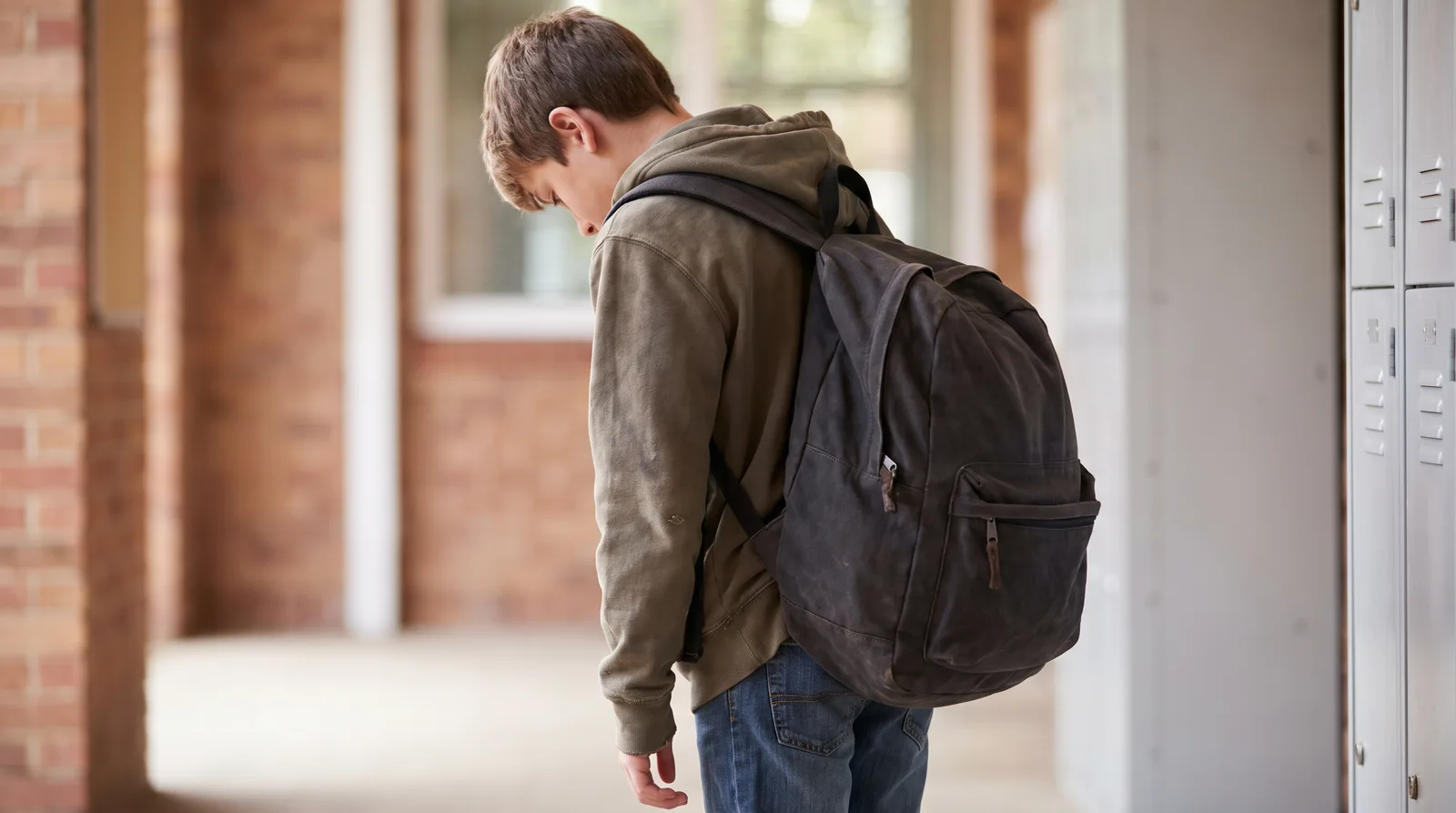
It’s a perfect headline for a worried group chat: kids as young as twelve are having spinal disc surgery: it’s the phones, it’s the backpacks, it’s the slouching. Cue every parent hoisting their child’s schoolbag and gasping at the weight.
So we did what we always do and went to the research. The twist is a good one: the scary headline is true. And almost every cause the panic pins it on is wrong.
Yes, it’s real, and yes, it’s genuinely rare
Let’s not soften the true part. Children really do occasionally need disc surgery, and it really does reach down to age 12. In one large children’s hospital’s 19-year series, the youngest patients were 12 (McAvoy et al., 2019). Age 12 is on the record.
Now the context that the headline conveniently drops. A review of the entire world’s medical literature on disc surgery in children aged 15 and under found just 69 cases, ever, across 28 studies, median age 13 (Loubeyre et al., 2024). Even at a high-volume spine centre, teenagers made up only 2.6% of all disc operations (Wang et al., 2013). And below age 10 it essentially doesn’t happen: scan 103 young children and you find zero herniations (Urrutia et al., 2016). Even when a herniation shows up on a teenager’s MRI (around 5.8% of scans), most is incidental, causing no symptoms and needing no surgery (Wan et al., 2023).
So the honest translation of the headline is: real, documented, and about as rare as childhood events get. Not an epidemic. Not your kid, almost certainly.
What actually causes it (spoiler: not the backpack)
Here’s where the panic really falls apart. When you look at what drives disc herniation in the young, the culprits are genetics and family history, direct trauma, heavy repetitive sports loading, and higher body weight (Qi et al., 2023). In that big hospital series, 71% were competitive athletes (McAvoy et al., 2019). These are gymnasts and weightlifters and rugby players loading a growing spine hard, not children ruined by sitting badly.
 Young discs don’t gently “wear out” from slouching the way the posters imply; they tend to fail from a specific injury or a genetic predisposition.
And the backpack? The single biggest review (69 studies, over 72,000 children) concluded there is “no convincing evidence that aspects of schoolbag use increase the risk of back pain” (Yamato et al., 2018). Not the weight, not how it’s worn. And that’s for ordinary back pain; the idea that backpacks cause disc herniations is weaker still. The one lifestyle factor with any foothold is prolonged sitting (a single retrospective study flagged sitting more than six hours a day), but even that measured sitting, not screens or bags, and it’s a world away from the confident “phones are snapping kids’ spines” narrative (Qi et al., 2023).
“But it’s rising!” Is it, though?
You’ll see it stated that adolescent disc herniation is climbing year on year. Being honest: we couldn’t find the data to back that up. The claim gets repeated in review articles as background, but without any solid population trend study behind it. What’s genuinely changed is that we scan far more freely now and spot more of it. “Always rare, better detected” is a fairer summary than “exploding.”
The reassuring ending
If the rare thing does happen, the outlook is good. Pooled data show leg pain and disability improving dramatically after surgery, with same-level reoperation around 1% in the short term (Than et al., 2024). And conservative treatment is tried first and usually works; surgery is the last resort after that fails (McAvoy et al., 2019). We’ll keep one honest caveat: over decades, a meaningful minority may need a further operation (Papagelopoulos et al., 1998). But “rare, treatable, and usually manageable without surgery” is the true shape of this.
When to actually see a doctor
Take it seriously if a child or teen has back or leg pain with numbness, tingling, or weakness, pain that wakes them or follows a real injury, or any change in bladder/bowel control. That warrants a proper assessment, not reassurance from a blog, and not a panic-bought gadget.
The honest bottom line
Twelve-year-olds getting disc surgery is real, documented, and extremely rare, and it’s driven by genes, trauma, and hard athletic loading, not by backpacks, phones, or ordinary slouching. The backpack scare is, on the best evidence, a myth. So retire the group-chat horror, keep an eye out for the genuine red flags, and don’t buy your kid a posture gadget to prevent something a posture gadget can’t prevent.
While we’re being straight: NeckCure is a tool for adults’ everyday waking posture and comfort: it will not prevent or treat a disc herniation, in a child or anyone else, and we’d never claim it does. If a young person has worrying back or leg symptoms, that’s a conversation for a doctor, full stop.
References
- McAvoy M, McCrea HJ, Chavakula V, et al. (2019). Long-term outcomes of lumbar microdiscectomy in the pediatric population: a large single-institution case seriesJournal of Neurosurgery: Pediatrics. PMID 31470400DOI 10.3171/2019.6.PEDS18716199 pediatric disc operations over 19 years (~10/year at a major children's hospital), mean age 16, range 12–18 — so age 12 is documented, at the extreme. Conservative care had failed in 98% first; 71% were competitive athletes.
- Loubeyre E, Terrier LM, Cognacq G, et al. (2024). Surgical management of herniated intervertebral disc in childrenNeurochirurgie. PMID 39241927DOI 10.1016/j.neuchi.2024.101593A review of the ENTIRE world literature on disc surgery in children aged 15 or under found only 69 surgical cases across 28 studies, median age 13. The main cause was trauma/repetitive microtrauma.
- Wang H, Cheng J, Xiao H, Li C, Zhou Y (2013). Adolescent lumbar disc herniation: experience from a large minimally invasive treatment centreClinical Neurology and Neurosurgery. PMID 23419406DOI 10.1016/j.clineuro.2013.01.019Even at a high-volume centre, teenagers were only 2.6% (121/4,695) of all disc-herniation operations over a decade; 31% had preceding trauma.
- Urrutia J, Zamora T, Prada C (2016). The prevalence of degenerative or incidental findings in the lumbar spine of pediatric patients: an MRI screening studyEuropean Spine Journal. PMID 26153679DOI 10.1007/s00586-015-4099-3103 children (mean age 6.6) scanned: ZERO disc herniations. In the first decade of life it is essentially non-existent — this is a late-adolescent phenomenon.
- Wan ZY, Zhang J, Shan H, et al. (2023). Epidemiology of lumbar degenerative phenotypes of children and adolescents: a large-scale imaging studyGlobal Spine Journal. PMID 33843321DOI 10.1177/21925682211000707597 under-18s imaged: disc herniation appeared on ~5.8% of scans — but most is incidental (seen on imaging, causing no symptoms and needing no surgery).
- Qi L, Luo L, Meng X, et al. (2023). Risk factors for lumbar disc herniation in adolescents and young adults: a case-control studyFrontiers in Surgery. PMID 36684299DOI 10.3389/fsurg.2022.1009568The strongest independent risk factors were BMI >30, family/genetic history, low-back trauma, and prolonged sitting (>6 h/day). It measured sitting time — not screens or backpacks. Retrospective, up to age 25.
- Yamato TP, Maher CG, Traeger AC, Williams CM, Kamper SJ (2018). Do schoolbags cause back pain in children and adolescents? A systematic reviewBritish Journal of Sports Medicine. PMID 29720469DOI 10.1136/bjsports-2017-09892769 studies, 72,627 children: 'no convincing evidence that aspects of schoolbag use increase the risk of back pain.' And that's for back pain — the evidence bags cause disc herniation is weaker still.
- Than CA, Valiotis AK, Prottoy AR, et al. (2024). Discectomy for lumbar disc herniation in pediatric and adolescent populations: a systematic review and meta-analysisCureus. PMID 39104990DOI 10.7759/cureus.63880Pooled 22 studies (n=1,182, age <21): leg pain and disability improved dramatically after surgery, same-level reoperation ~1% short-term. When surgery is needed, it works well — but there are no trials vs conservative care.
- Papagelopoulos PJ, Shaughnessy WJ, Ebersold MJ, Bianco AJ Jr, Quast LM (1998). Long-term outcome of lumbar discectomy in children and adolescents sixteen years of age or youngerJournal of Bone and Joint Surgery (American). PMID 9611029DOI 10.2106/00004623-199805000-0000972 patients, ~28-year follow-up: 92% had no/occasional pain — but 28% needed at least one reoperation over the decades. Honest nuance: good outcomes, not always one-and-done.
- Abe T, Miyakoshi N, Hongo M, et al. (2013). Symptomatic cervical disc herniation in teenagers: two case reportsJournal of Medical Case Reports. PMID 23402661DOI 10.1186/1752-1947-7-42States plainly that a symptomatic herniated NECK disc before age 20 is 'extremely rare' — rarer than the lumbar version, and usually tied to calcification or trauma.