Neck pain
Why does your neck ache, and when should you actually worry?
Neck and shoulder ache is one of the most common complaints on earth, and one of the most misunderstood. Here's what's usually behind it, why it's rarely what you fear, the handful of signs that do deserve a doctor, and why 'bad posture' gets more blame than the evidence supports.
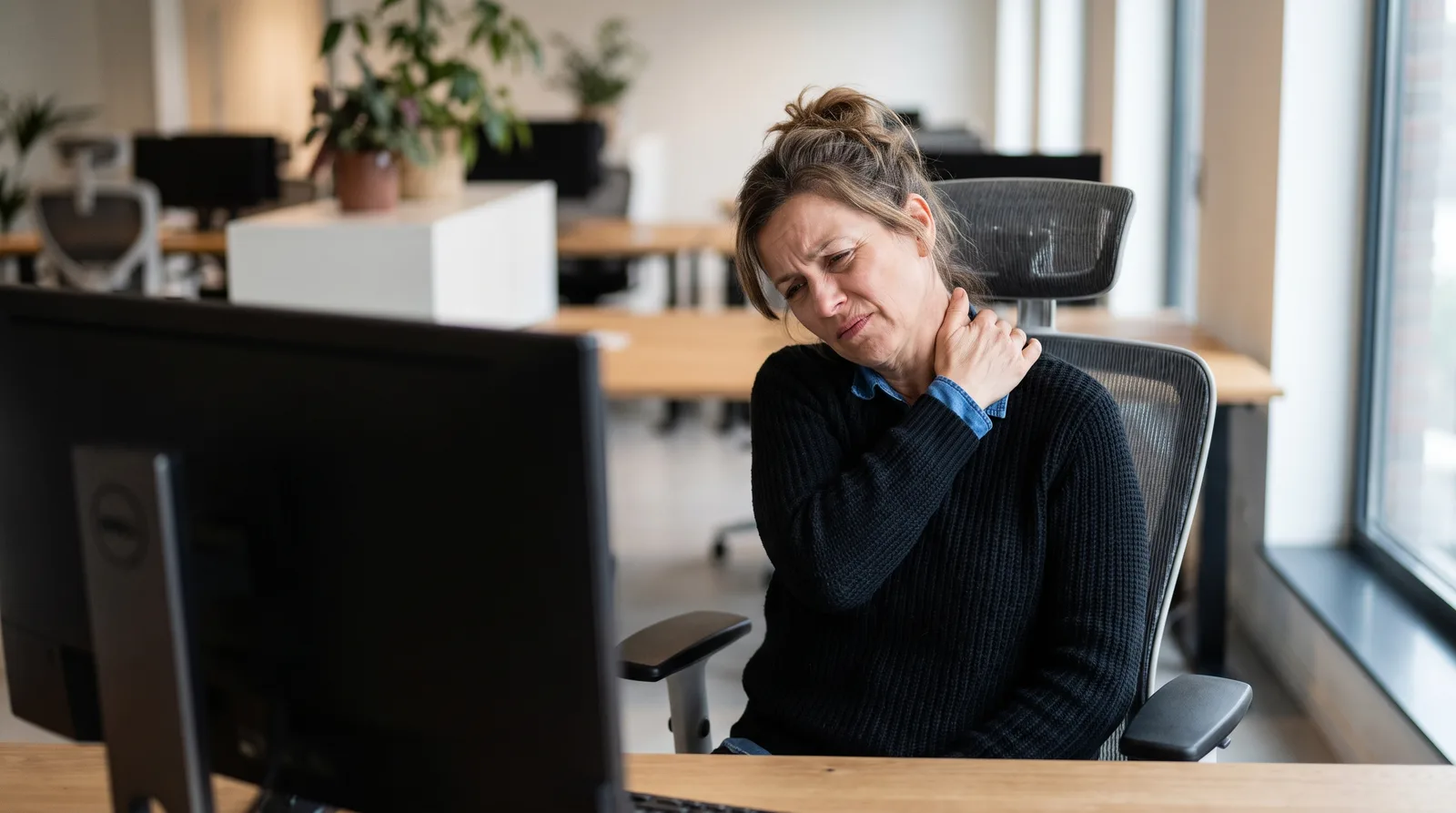
If your neck or shoulders ache right now, here’s the first, weirdly comforting fact: you are in enormous company. Neck pain is one of the leading causes of disability on the entire planet: it ranks fourth worldwide for years lived with disability, and roughly 203 million people had it in a single recent year (Hoy et al., 2014; GBD 2021 Neck Pain Collaborators, 2024). More than 30% of us get it in any given year (Cohen, 2015). If it feels like everyone’s neck hurts, that’s because it nearly does.
So let’s do the useful thing: explain what’s usually going on, defuse the scary version, and be crystal clear about the rare signs that actually warrant a doctor.
The reassuring truth: it’s almost always “non-specific”
Doctors sort neck pain into a simple ladder (Guzman et al., 2008). At the top, the common stuff: non-specific or mechanical neck pain, an achy, stiff, sometimes miserable neck with no single broken structure to point at. In the middle, a smaller group with a pinched nerve root. At the bottom, a rare few with serious disease.
The overwhelming majority of us live at the top of that ladder. “Non-specific” sounds unsatisfying (we want a villain, a slipped this or a trapped that), but it’s actually good news: it means nothing is damaged. The honest picture is that everyday neck ache is multifactorial: muscle tension, how much you move, stress and mood, sleep, overall load. It’s less “something snapped” and more “a lot of small things stacked up.” Most acute episodes settle, though, being honest, nearly half of people get some recurrence (Cohen, 2015). Annoying, yes. Dangerous, almost never.
The posture plot-twist: it’s not the culprit you were sold
Here’s where we’ll gently disagree with every wall poster. The belief that bad posture causes neck pain is far shakier than it’s treated. When researchers pooled the studies on forward-head posture, adults with neck pain had slightly more of it, but the link was weak, it was based on snapshots that can’t prove cause, and in adolescents there was no association at all (Mahmoud et al., 2019). A review of office workers found the evidence that physical and postural factors actually cause neck pain is limited and inconsistent (Jun et al., 2017). Meanwhile, psychosocial factors like stress and low mood show up as consistent predictors (Linton, 2000).
Translation: your slouch is probably a passenger, not the driver. Which is oddly freeing: it means you can stop treating your neck like a fragile tower that will topple the moment you round your shoulders. (We’ve unpacked the wider “is slouching bad?” question here.)
The part to take seriously: the red flags
Now the important exception, because “usually benign” is not “always.” A small number of necks are trying to tell you something, and these signs deserve a professional, not a blog:
- Arm symptoms: pain, numbness, tingling, or weakness shooting down one arm can mean a pinched nerve root (Radhakrishnan et al., 1994). Often settles, but get it assessed.
- Signs of spinal-cord pressure: increasingly clumsy hands (buttons, coins), an unsteady walk or balance, or bladder/bowel changes. This one, degenerative cervical myelopathy, is easy to miss early and genuinely important to catch (Davies et al., 2018).
- Systemic red flags: unexplained weight loss, fever, night pain that won’t ease, a history of cancer, or pain after a significant injury.
If any of those apply, stop reading and book an appointment. Everything below is for the ordinary achy neck, not these.
So what actually helps the everyday kind?

Undramatic things, mostly, and notably not buying the perfect posture:
- Move it and use it. Specific neck and shoulder-blade exercises genuinely help pain and function (Gross et al., 2015), and staying active beats resting up. (We rounded up the moves with the best evidence here.)
- Don’t freeze in one position. The problem is usually staying still for hours, not the exact angle you’re still in. Break it up.
- Mind the whole picture. Sleep, stress, and general activity all feed into it; treating the neck in isolation misses half the story.
- Be reassured. Clinical guidelines put exercise, activity, and education that it’s usually not serious right at the front (Blanpied et al., 2017). Fear and guarding tend to make pain worse, not better.
The honest bottom line
An aching neck is incredibly common, almost always non-specific and benign, driven by a tangle of factors rather than one broken part, and much less about your posture than the posters claim. Learn the handful of red flags, take those seriously, and for the ordinary stuff: keep moving, don’t marinate in one position, and go easy on yourself.
That “don’t marinate in one position” is the sliver we built NeckCure for. It won’t diagnose your neck or replace a clinician, and it certainly won’t lecture you about a perfect pose that the evidence doesn’t even support. It just notices when you’ve frozen into the same slump for too long and nudges you to move, because breaking up the static hours is one of the few things here that genuinely helps.
References
- Hoy D, March L, Woolf A, et al. (2014). The global burden of neck pain: estimates from the Global Burden of Disease 2010 studyAnnals of the Rheumatic Diseases. PMID 24482302DOI 10.1136/annrheumdis-2013-204431Neck pain ranked 4th worldwide for years lived with disability — it is genuinely one of the most common causes of everyday suffering. (Modelled estimates.)
- GBD 2021 Neck Pain Collaborators (2024). Global, regional, and national burden of neck pain, 1990-2020, and projections to 2050The Lancet Rheumatology. PMID 38383088DOI 10.1016/S2665-9913(23)00321-1Around 203 million people had neck pain in 2020; burden higher in women; projected to keep rising. The most recent global estimate.
- Cohen SP (2015). Epidemiology, diagnosis, and treatment of neck painMayo Clinic Proceedings. PMID 25659245DOI 10.1016/j.mayocp.2014.09.008Annual prevalence >30%; most acute neck pain settles, but nearly half of people have persistent or recurring symptoms; the majority is 'mechanical'/non-specific with no single structural cause.
- Guzman J, Hurwitz EL, Carroll LJ, et al. (2008). A new conceptual model of neck pain: linking onset, course, and care (Bone and Joint Decade Task Force on Neck Pain)Spine. PMID 18204387DOI 10.1097/BRS.0b013e3181643efbThe standard grading: Grade I–II = no serious pathology (the vast majority), Grade III = nerve-root signs, Grade IV = serious pathology (rare). The basis for 'mostly benign, occasionally nerve, rarely serious.'
- Radhakrishnan K, Litchy WJ, O'Fallon WM, Kurland LT (1994). Epidemiology of cervical radiculopathy: a population-based study from Rochester, Minnesota, 1976 through 1990Brain. PMID 8186959DOI 10.1093/brain/117.2.325Cervical radiculopathy (a pinched nerve root — arm pain/numbness/weakness) is comparatively uncommon (~83 per 100,000/year) and most people recover.
- Mahmoud NF, Hassan KA, Abdelmajeed SF, Moustafa IM, Silva AG (2019). The relationship between forward head posture and neck pain: a systematic review and meta-analysisCurrent Reviews in Musculoskeletal Medicine. PMID 31773477DOI 10.1007/s12178-019-09594-yIn adults, forward-head posture is weakly associated with neck pain; in adolescents there was NO association. Cross-sectional data — association, not proven cause, and confounded by age.
- Jun D, Zoe M, Johnston V, O'Leary S (2017). Physical risk factors for developing non-specific neck pain in office workers: a systematic review and meta-analysisInternational Archives of Occupational and Environmental Health. PMID 28224291DOI 10.1007/s00420-017-1205-3Prospective office-worker data: evidence for most physical/postural risk factors causing neck pain is limited or inconsistent — a key counterweight to the 'bad posture causes it' story.
- Linton SJ (2000). A review of psychological risk factors in back and neck painSpine. PMID 10788861DOI 10.1097/00007632-200005010-00017Psychosocial factors — stress, mood, job satisfaction — are consistently linked to onset and persistence of neck/back pain. Pain is multifactorial, not just mechanical.
- Davies BM, Mowforth OD, Smith EK, Kotter MR (2018). Degenerative cervical myelopathyBMJ. PMID 29472200DOI 10.1136/bmj.k186The serious one to catch: spinal-cord compression. Warning signs include clumsy hands, unsteady gait/balance, and bladder changes — get these assessed promptly.
- Gross A, Kay TM, Paquin JP, et al. (2015). Exercise for mechanical neck disordersCochrane Database of Systematic Reviews. PMID 25629215DOI 10.1002/14651858.CD004250.pub5Specific neck/shoulder-blade strengthening and stretching help pain and function in mechanical neck pain — low-to-moderate quality evidence.
- Blanpied PR, Gross AR, Elliott JM, et al. (2017). Neck pain: Revision 2017 — clinical practice guidelinesJournal of Orthopaedic & Sports Physical Therapy. PMID 28666405DOI 10.2519/jospt.2017.0302Evidence-based guideline: exercise, staying active, and reassurance/education are front-line; screen for red flags. 'Fix your posture' alone is not the headline treatment.