Exercises
5 neck moves that actually work, and the famous one that doesn't
The internet is stuffed with neck stretches. When scientists actually test them, the results are blunt: strengthening beats stretching, the crowd-favourite stretch barely helps, and the single best 'exercise' is the one nobody's selling you.

Search “neck stretch” and you’ll drown. Everyone has one: the influencer, the physio reel, the ergonomic-chair ad. The strange part is that when researchers put these moves through actual trials, the results are surprisingly blunt: some genuinely help, the single most famous one hardly makes a difference, and the best “exercise” of all is something nobody bothers to sell because you can’t monetise it.
So here’s the honest ranking, straight from the trials.
First, the big finding: moving actually works
Let’s start with the good news, because it’s solid. Exercise genuinely reduces and prevents neck pain in office workers. A systematic review pooling workplace trials found real benefit (Chen et al., 2018); a meta-analysis of randomised trials found exercise cut the risk of a new neck-pain episode by about half (OR 0.49; Teichert et al., 2023); and a year-long trial of 567 office workers dropped new neck pain from 27% to 12% (Sihawong et al., 2014). This is moderate-quality evidence, not wishful thinking.
But which moving? That’s where it gets spicy.
The plot twist: strengthening beats stretching
Here’s the part the stretch-of-the-day crowd won’t love. In that big review, it was strengthening that carried the benefit, while stretching alone showed no detectable effect (Chen et al., 2018). The landmark JAMA trial found the same: active strength and endurance training beat a stretch-and-advice control for both pain and disability (Ylinen et al., 2003).
We’ll stay honest, though: it’s not a knockout. One head-to-head found that once people actually kept it up, adding strength work to stretching wasn’t dramatically better than stretching on its own (Häkkinen et al., 2008). The real lesson isn’t “stretching is useless”: it’s do active training, and do it consistently. Which brings us to the moves that earn their place.
The 5 that actually earn their keep
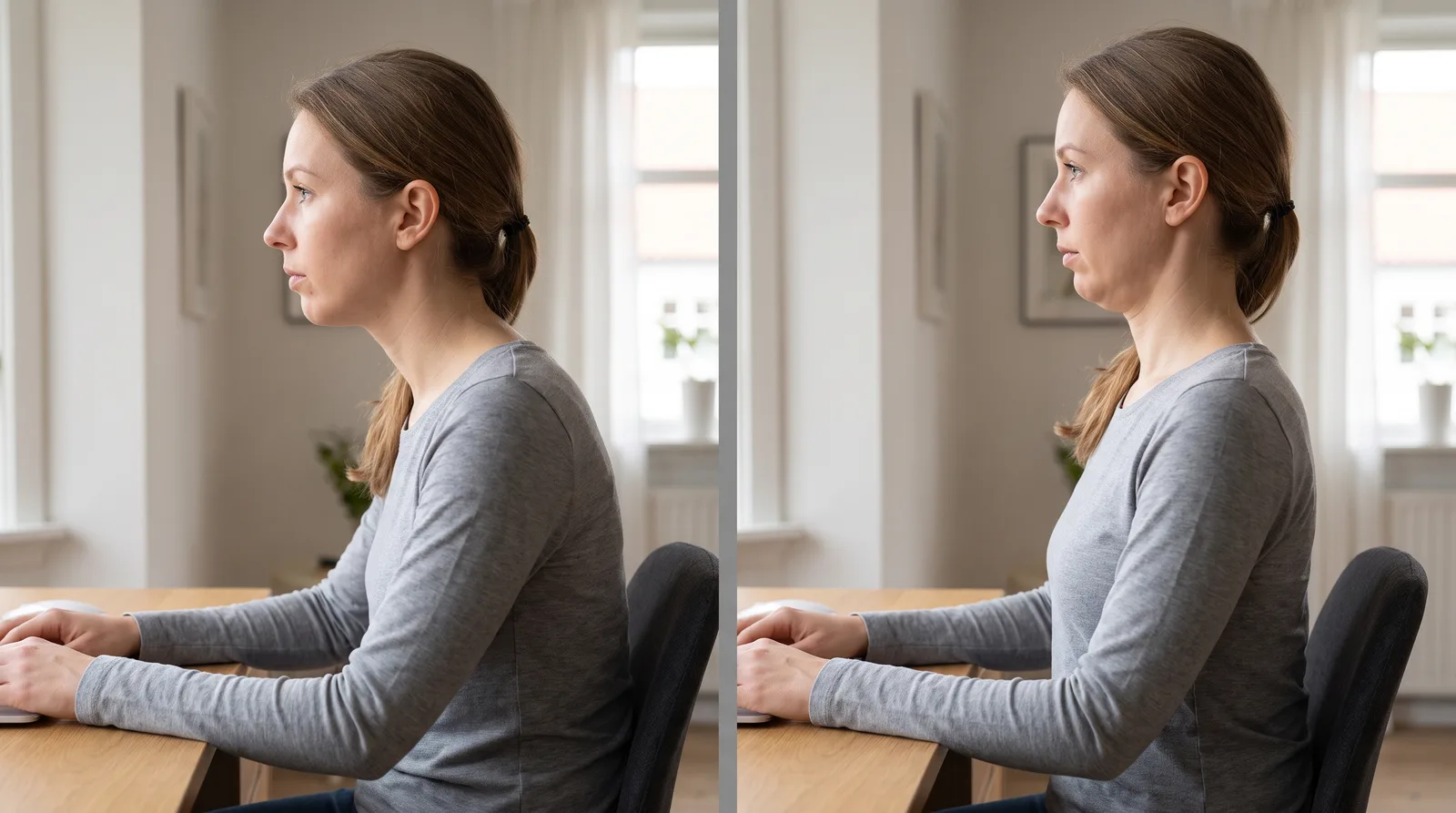
1. The chin tuck (a.k.a. deep cervical flexor training). This is the best-evidenced move on the list. Gently draw your head straight back (making a temporary “double chin”), hold briefly, release. A systematic review of 12 trials found it retrains the deep stabilising muscles and improves head-and-neck posture (Blomgren et al., 2018), and a 200-person trial showed this exact low-load training cut neck pain and cervicogenic headaches, still holding a year later (Jull et al., 2002).
2. Shoulder-blade squeezes. Draw your shoulder blades gently down and back: think slow rowing without the weights. A randomised trial of office workers found ten weeks of this shoulder-blade strengthening cut neck/shoulder pain by a clinically meaningful amount (Andersen et al., 2014).

3. Light neck endurance work. Not gym-heavy: just training the neck to hold rather than fatigue. This is the “active training” that beat passive stretching in the trials above (Ylinen et al., 2003; Sihawong et al., 2014).
4. The active break: the quiet superstar. Every so often, get up, change what your body’s doing, and move. In a trial of high-risk office workers, people prompted to take active breaks and shift posture had new neck pain of 17%, versus 44% in the do-nothing group (Waongenngarm et al., 2021). No fancy move required, just don’t stay frozen.
5. The upper-trapezius stretch: fine, but manage your expectations. The famous “ear-to-shoulder” stretch feels lovely, and there’s nothing wrong with a moment of relief. Just know it’s the crowd-favourite that the evidence is coolest on: stretching alone didn’t show benefit as a fix (Chen et al., 2018). Enjoy it as a break, not as your treatment plan.
The best “exercise” nobody sells you
Notice the thread running through the winners: the magic isn’t a perfect posture you lock into: it’s not staying in one. The best posture really is your next one. But one honest caveat, because the internet loves a rule: simply pausing on a timer isn’t the fix. A Cochrane review found that just changing how often you take breaks had no clear effect (Luger et al., 2019). It’s not the pause that helps: it’s the movement you put in it (Waongenngarm et al., 2021).
And the thing that makes or breaks all of this? Consistency. The trials that worked are the trials where people actually kept going. The fanciest routine you abandon in a week beats nothing by exactly nothing.
When to get it checked
Quick serious note: see a health professional if your neck pain is severe, persistent, or worsening, or if you get numbness, tingling, or weakness spreading into an arm. Exercises are for everyday stiffness, not for red-flag symptoms.
The honest bottom line
Skip the endless stretch reels. What the science actually rewards is light, consistent strengthening (chin tucks, shoulder-blade squeezes, a bit of neck endurance), plus the unsexy winner of getting up and moving before you’ve marinated in one position for hours.
That last one is the whole reason NeckCure exists. It won’t do your chin tucks for you, but it’s the gentle nudge that gets you to do the single best-evidenced thing on this list: notice you’ve frozen, and move. The exercises are yours. We just make sure you actually take the break.
References
- Chen X, Coombes BK, Sjøgaard G, Jun D, O'Leary S, Johnston V (2018). Workplace-based interventions for neck pain in office workers: systematic review and meta-analysisPhysical Therapy. DOI 10.1093/ptj/pzx101The strongest single source. Neck/shoulder STRENGTHENING gave a moderate benefit (SMD 0.59). Stretching alone showed no detectable benefit.
- Teichert F, Karner V, Döding R, et al. (2023). Effectiveness of exercise interventions for preventing neck pain: a systematic review with meta-analysis of randomized controlled trialsJournal of Orthopaedic & Sports Physical Therapy. DOI 10.2519/jospt.2023.12063Meta-analysis of 5 RCTs (1722 people, mostly office workers): exercise cut the risk of a new neck-pain episode (OR 0.49), moderate-certainty.
- Sihawong R, Janwantanakul P, Jiamjarasrangsi W (2014). Effects of an exercise programme on preventing neck pain among office workers: a 12-month cluster-randomised controlled trialOccupational and Environmental Medicine. PMID 24142988DOI 10.1136/oemed-2013-101561567 office workers: stretching + neck endurance training cut new neck pain from 26.7% to 12.1% (HR 0.45).
- Ylinen J, Takala EP, Nykänen M, et al. (2003). Active neck muscle training in the treatment of chronic neck pain in women: a randomized controlled trialJAMA. PMID 12759322DOI 10.1001/jama.289.19.2509Landmark RCT (n=180): active strength/endurance training beat a stretching-and-advice control for pain and disability.
- Häkkinen A, Kautiainen H, Hannonen P, Ylinen J (2008). Strength training and stretching versus stretching only in the treatment of patients with chronic neck pain: a randomized one-year follow-up studyClinical Rehabilitation. PMID 18586810DOI 10.1177/0269215507087486Honest counterweight: once done consistently, adding strength work to stretching wasn't dramatically better than stretching alone. Don't oversell 'strength beats stretch'.
- Blomgren J, Strandell E, Jull G, Vikman I, Röijezon U (2018). Effects of deep cervical flexor training on impaired physiological functions associated with chronic neck pain: a systematic reviewBMC Musculoskeletal Disorders. PMID 30486819DOI 10.1186/s12891-018-2324-z12 RCTs, 502 people: deep cervical flexor ('chin tuck') training improves neuromuscular control and head/neck posture.
- Jull G, Trott P, Potter H, et al. (2002). A randomized controlled trial of exercise and manipulative therapy for cervicogenic headacheSpine. PMID 12221344n=200: low-load chin-tuck-type training significantly reduced headache and neck pain, holding at 12 months.
- Andersen CH, Andersen LL, Zebis MK, Sjøgaard G (2014). Effect of scapular function training on chronic pain in the neck/shoulder region: a randomized controlled trialJournal of Occupational Rehabilitation. PMID 23832167DOI 10.1007/s10926-013-9441-1RCT (n=47 office workers): 10 weeks of shoulder-blade strengthening cut pain by a clinically relevant 2.0 points.
- Waongenngarm P, van der Beek AJ, Akkarakittichoke N, Janwantanakul P (2021). Effects of an active break and postural shift intervention on preventing neck and low-back pain among high-risk office workers: a 3-arm cluster-randomized controlled trialScandinavian Journal of Work, Environment & Health. PMID 33906239DOI 10.5271/sjweh.3949New neck pain 17% with active breaks / postural shifts vs 44% in controls. Strong support for moving, not for one 'correct' pose.
- Luger T, Maher CG, Rieger MA, Steinhilber B (2019). Work-break schedules for preventing musculoskeletal symptoms and disorders in healthy workersCochrane Database of Systematic Reviews. PMID 31334564DOI 10.1002/14651858.CD012886.pub2Honest caveat: simply changing break FREQUENCY (pausing on a timer) showed low-quality/no clear effect. What you do in the break — move — is what matters.