Posture
Can slouching really make you go bald?
There's a corner of the internet convinced that hunching over your desk strangles your scalp and thins your hair. It sounds almost logical, so we went looking for the evidence. What we found (and didn't find) is a perfect lesson in telling a real mechanism from a good story.

Somewhere between the neck-cracking videos and the “fix your posture in 30 days” reels, you’ll find a claim that sounds almost too tidy: slouch all day, and the constant tension pulls your scalp taut, chokes off the blood, and, one clogged follicle at a time, your hair gives up. Straighten your spine, save your hairline. It’s the kind of theory that feels like it should be true.
So we did the unglamorous thing and went to check. And the honest headline is this: when you look for actual evidence that posture makes you bald, you find a hole where the evidence should be.
First, the null result nobody mentions
We ran the searches you’d hope someone had run before repeating the claim online. “Posture, scalp tension, hair loss.” “Forward head posture and alopecia.” “Slouching and hair loss.” Across the medical literature, the number of studies actually linking adult body posture to going bald is, as far as we can find, zero.
Not “weak.” Not “mixed.” Just absent. The single result that even brushed the topic was a 1997 paper about infants’ heads flattening from lying in one position, thinning hair over the flat spot, entirely unrelated to how you sit at your laptop (Chadduck et al., 1997). That’s the whole harvest.
A missing study isn’t proof the effect is impossible. But when a claim is repeated this confidently and has left no footprint in the research, that’s your first clue you’re looking at a story, not a finding.
So where did the idea even come from? Meet the “scalp-tension” hypothesis
The theory isn’t pure invention; it has a respectable-sounding cousin in the literature. A handful of papers have proposed that chronic tension in the scalp (or even the sheer weight of it under gravity) could drive inflammation and feed the hormonal process behind baldness (English, 2018; Ustuner, 2008, 2013).
Here’s the important small print, though. These are hypothesis papers (published in journals literally built for floating untested ideas), not experiments that demonstrated anything. One of the authors even holds a patent tied to the mechanism he’s proposing, which is worth knowing. A hypothesis is where science starts a conversation, not where it settles one. Treating “someone published a plausible idea” as “science says slouching causes baldness” is exactly the leap that turns a maybe into a myth.

“But bald scalps have worse blood flow!”
This is the part that gets recycled the most, and it’s half-true in the most misleading way. Researchers have measured lower oxygen levels in the skin of balding scalps compared with hairy ones (Goldman et al., 1996). Real finding. The problem is the arrow.
A shrinking, miniaturising hair follicle needs less blood, so poorer perfusion in a bald patch is most plausibly a consequence of the hair loss already happening, not the thing that caused it. It’s like noticing that abandoned houses have overgrown gardens and concluding the weeds evicted the tenants. And the “just boost circulation and regrow hair” pitches? Even Botox (injected specifically to relax the scalp and improve flow) only rates a cautious “promising” in the best current review, off small and limited studies (Cheng et al., 2025). Not the slam dunk the theory needs.
What actually makes you bald (the boring, settled answer)
Pattern hair loss isn’t a mystery the internet is about to crack with a posture tip. The overwhelming driver is genetics plus androgens: chiefly a hormone called DHT that, in genetically susceptible follicles, gradually shrinks them until they stop producing visible hair. We know this partly because the treatments that actually work target exactly that pathway: finasteride, which lowers DHT, and minoxidil (York et al., 2020). Notice what isn’t on the list of proven treatments: sitting up straight.
The one place mechanical force does steal your hair
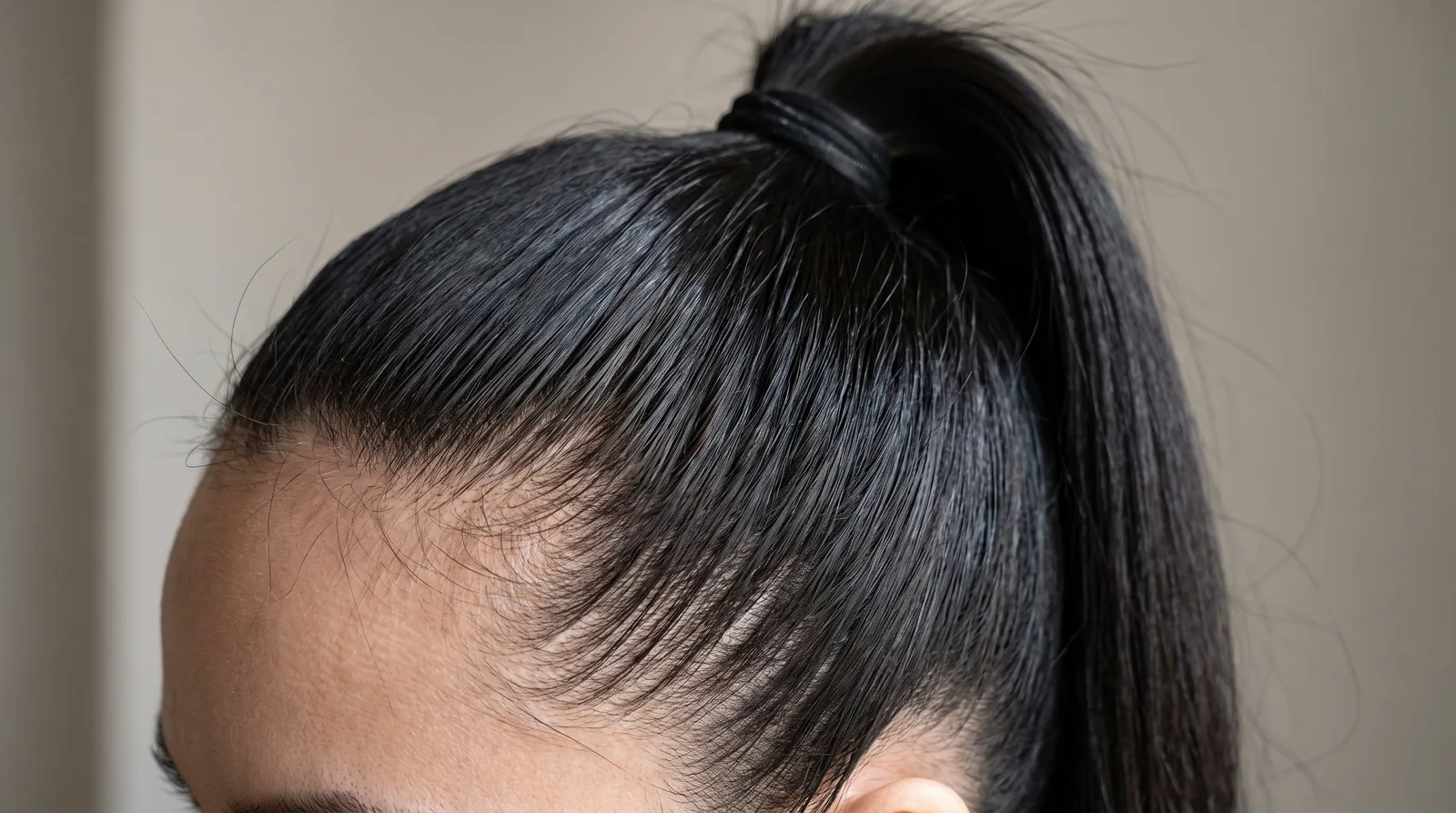
Here’s the twist that makes the myth so sticky, because there’s a grain of truth buried in it. Mechanical force on your hair really can cause hair loss. It’s called traction alopecia, and it comes from tight ponytails, braids, buns and extensions that yank on the follicles day after day until they give out (Afifi et al., 2021).
But read that carefully: it’s direct pulling on the hair itself, not the diffuse “tension” of a hunched posture. Your slouch doesn’t tug on individual follicles the way a scraped-back bun does. So yes, tension can cost you hair, which is probably why the posture version sounds believable. It’s just the wrong kind of tension, in the wrong place.
When hair loss is worth a real appointment
Quick serious note, because hair loss can occasionally flag something medical. If your hair is falling out suddenly, in patches, in clumps, or alongside itching, scaling, pain or other symptoms, see a dermatologist, not a posture coach. Sudden or patchy loss can point to things (thyroid issues, autoimmune conditions, nutritional deficiencies) that deserve a proper diagnosis. Genuine treatments for pattern baldness exist too, and a doctor can point you to the ones with evidence behind them.
The honest verdict
Does slouching make you go bald? On the evidence: no. There’s no study showing it, the “scalp tension” idea is an untested hypothesis, and the blood-flow argument most likely has cause and effect backwards. Pattern baldness runs on genes and hormones, not on how you sat through your Tuesday meetings.
Which is where we’ll be straight with you about what a posture app is for. NeckCure will not save your hairline, regrow a follicle, or do a single thing DHT cares about. And anyone selling a posture gadget on a hair-loss promise is selling you the myth. What sitting tall genuinely earns you is the stuff we can actually back: easier breathing and a small energy lift, and less of the daytime neck load that leaves you stiff and sore. That’s a good enough reason to straighten up. Your hair, meanwhile, is answering to your grandparents, not your chair.
References
- English RS Jr (2018). A hypothetical pathogenesis model for androgenic alopecia: clarifying the dihydrotestosterone paradox and rate-limiting recovery factorsMedical Hypotheses. PMID 29407002DOI 10.1016/j.mehy.2017.12.027A hypothesis paper, not experimental evidence — proposes a chronic scalp-tension / inflammation / DHT model. An idea to test, not a proven mechanism.
- Ustuner ET (2008). Baldness may be caused by the weight of the scalp: gravity as a proposed mechanism for hair lossMedical Hypotheses. PMID 18667278DOI 10.1016/j.mehy.2008.05.030Hypothesis paper proposing a scalp-weight/gravity mechanism. Author holds a related patent (disclosed conflict of interest).
- Ustuner ET (2013). Cause of androgenic alopecia: crux of the matterPlastic and Reconstructive Surgery – Global Open. PMID 25289259DOI 10.1097/GOX.0000000000000005Opinion/hypothesis by the same author extending the tension idea; conflict of interest disclosed. Not causal evidence.
- Goldman BE, Fisher DM, Ringler SL (1996). Transcutaneous PO2 of the scalp in male pattern baldness: a new piece to the puzzlePlastic and Reconstructive Surgery. PMID 8628793DOI 10.1097/00006534-199605000-00003Small comparative study: balding scalp shows lower oxygen than haired scalp — an association, most likely a consequence of hair loss, not proof of its cause.
- Cheng F, Cai X, Zhang Y, Wu J, Yin S (2025). Effects and safety of botulinum toxin injection in treatment of androgenetic alopecia: a meta-analysis and systematic reviewDermatologic Surgery. PMID 39840856DOI 10.1097/DSS.0000000000004557Meta-analysis of Botox for hair loss — results described only as 'promising'; small, limited studies. Not a green light.
- York K, Meah N, Bhoyrul B, Sinclair R (2020). A review of the treatment of male pattern hair lossExpert Opinion on Pharmacotherapy. PMID 32066284DOI 10.1080/14656566.2020.1721463Review of the proven treatments — finasteride (which lowers DHT) and minoxidil — i.e. the evidence points at androgens/DHT, not posture.
- Afifi L, Oparaugo NC, Hogeling M (2021). Review of traction alopecia in the pediatric patient: diagnosis, prevention, and managementPediatric Dermatology. PMID 34467569DOI 10.1111/pde.14773Review (pediatric scope) of traction alopecia: sustained mechanical PULLING from tight hairstyles genuinely causes hair loss — direct tension on follicles, nothing to do with sitting posture.
- Chadduck WM, Kast J, Donahue DJ (1997). The enigma of lambdoid positional moldingPediatric Neurosurgery. PMID 9485158DOI 10.1159/000121210Case series on infant positional head molding; the flattened-area hair thinning is incidental and unrelated to adult posture. The only thing PubMed surfaces for 'posture + hair loss'.