Ancient Greece
The words on your spine X-ray are 2,400-year-old Greek, and the Greeks made posture into medicine
Kyphosis, lordosis, scoliosis, the terms on a modern spine report were coined by a Greek doctor around 400 BCE. The Greeks were the first to treat how you hold your body as medicine. Here's what they got right about the upright spine, and how much of it modern research has since confirmed.
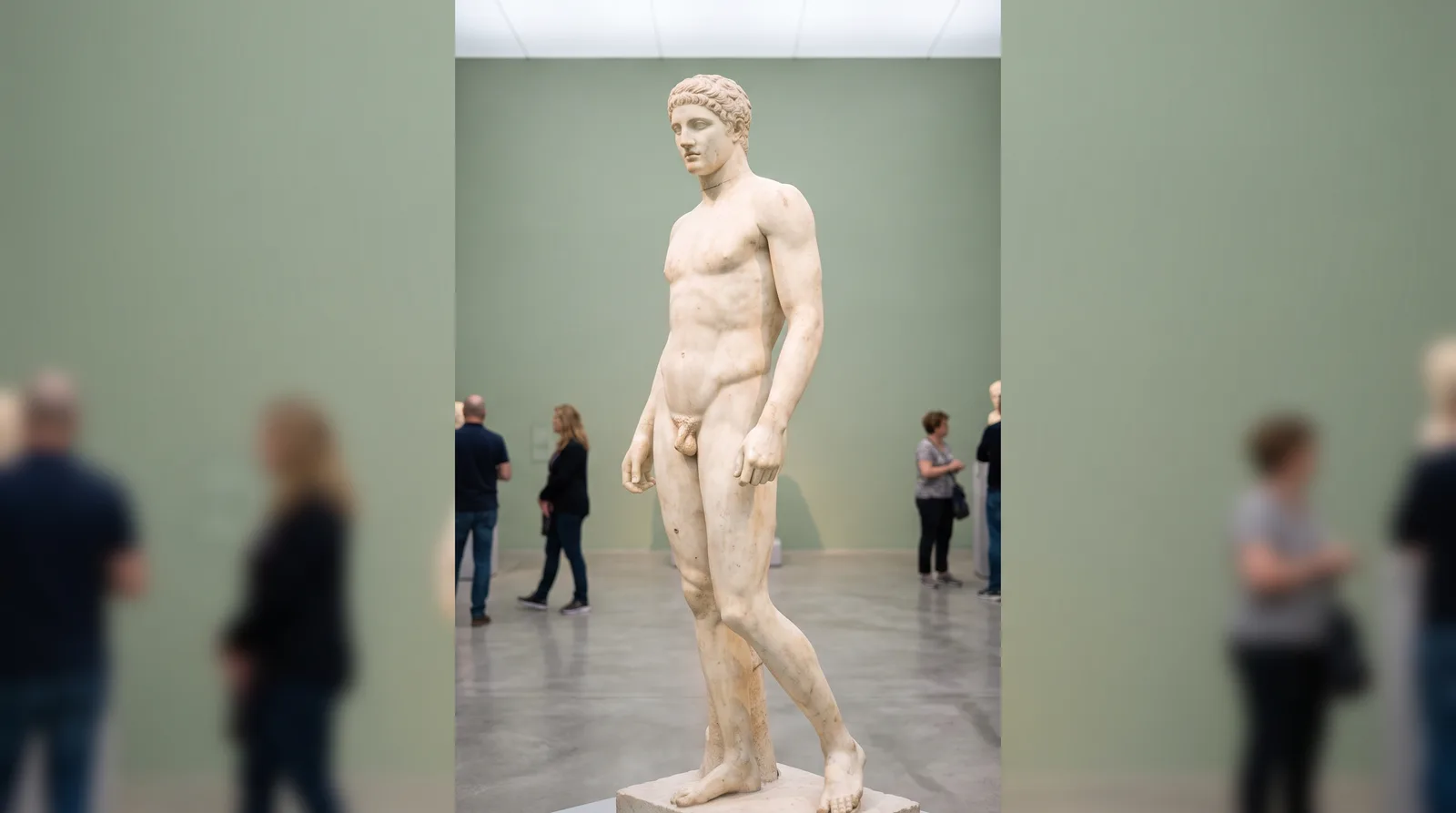
Look at a modern spine X-ray report and you’ll find three words waiting for you: kyphosis, lordosis, scoliosis. They sound like cutting-edge clinical Latin. They are not. They are ancient Greek, and a doctor coined them around 400 BCE, roughly 2,400 years before your radiologist typed them into a screen.
The man was Hippocrates, and when he wrote them down he wasn’t just naming shapes. He was doing something new: turning the way a body is held, its curves, its uprightness, its collapse, into medicine. This article starts with that short story, and then gets to the part that actually matters to you: what the Greeks prized about an upright spine, and how much of it modern research has since confirmed.
The lead-in: how Greece made posture into medicine
First, the cast. Hippocrates (c. 460-370 BCE) is the physician usually called the “father of medicine”, the figure behind the doctors’ oath. Galen (c. 129-216 CE) came about six centuries later and became the most influential physician of the ancient world; his ideas ruled European medicine for over a thousand years.
In his treatise On Joints, Hippocrates gave the spine a vocabulary. He named its curves and its deformities with words we still use:
- Kyphosis, from the Greek kyphos, meaning “hump”, the outward, hunched curve of the upper back.
- Lordosis, the inward curve, the one your lower back is supposed to have.
- Scoliosis, a sideways twist of the spine.
He didn’t just label them. He described the spine’s normal curves and its individual vertebrae with an accuracy that still impresses anatomists (Vasiliadis et al., 2009). Centuries later, Galen, in On the Usefulness of the Parts of the Body, framed the spine as a foundation of the body, one that has to combine two opposite things at once: stability and mobility. Rigid enough to hold you up, flexible enough to let you move.
And around all this sat a whole culture that idealised the upright, trained, balanced body, the gymnasium, the athletic ideal, the marble statues of runners and discus-throwers standing tall. To the Greeks, a well-held body wasn’t just healthy. It was beautiful, and a little bit admirable.
So they prized the upright spine. The interesting question is whether that instinct was right. Here’s the main event.
The main event: the Greeks valued the upright body, and here’s what modern research finds
They prized the calm, upstanding bearing → today it measures as better mood
The Greek athletic ideal wasn’t only about muscle; it was about bearing, standing composed and upright. It turns out that bearing does something to the mind. In a randomized trial, researchers held people in either an upright or a slumped posture and then put them through a stressful task. The upright group came out reporting higher self-esteem, better mood, and less fear than the slumpers (Nair et al., 2015). The Greeks admired the person who stood tall and unshaken; modern psychology finds that standing tall genuinely shifts how you feel while you’re under pressure.
They built their culture around breath and athletics → upright sitting measures as stronger breathing
The gymnasium culture ran on breath, running, wrestling, endurance. The Greeks would not have been surprised to learn what a slouch does to your lungs. When researchers measured respiratory-muscle strength in the same people sitting two ways, upright versus slouched, the upright posture produced measurably stronger breathing muscles (Albarrati et al., 2018). Collapse your chest and you cramp the very machinery that fills your lungs. Sit tall and you give the diaphragm room to work. The Greek instinct that an open, upright chest is a healthier chest lands on real mechanics.
They named the hump → the hump, centuries later, predicts something serious
Here’s where the Greek vocabulary comes full circle, almost eerily. Hippocrates named the outward hunch kyphosis. Skip forward two and a half millennia and a modern prospective study followed more than a thousand older adults. Those with a markedly hunched posture, hyperkyphosis, the Greek word made literal, had roughly 1.4 times higher mortality than their straighter-backed peers (Kado et al., 2004). The word he coined to describe a shape now describes a risk.
But be careful with this one, because it’s the easiest to misread. The kyphosis in that study is the structural curvature of old age, the kind often tied to weakened, fractured vertebrae, not the temporary slump of someone hunched over a laptop. And it’s an association: the hunched people died sooner, but that is not proof that your desk slouch is shortening your life. It’s a reason to protect the upright spine over decades, not a verdict on this afternoon’s posture.
The honest part: their theory was mostly wrong
Now the firewall, because it matters. It would be easy to read all this as “the ancient Greeks had it figured out.” They didn’t.
Greek medicine ran mostly on the theory of the four humours, the idea that health was a balance of blood, phlegm, yellow bile and black bile, and that illness came from those fluids going out of proportion. That entire framework is obsolete and simply wrong. It has no standing in modern medicine. For centuries it led doctors to bleed and purge patients on a false theory of disease.
So what actually survives from the Greeks isn’t their explanation of the body. It’s their observation of it. Hippocrates looked at spines carefully enough to name their curves correctly, and those names still work. Galen was right that the spine has to be both stable and mobile. The Greeks valued the upright body, and modern measurement keeps agreeing that the upright body breathes better, feels steadier, and ages with less of that dangerous hump. The theory was a dead end. The looking was not. Don’t let the good observations trick you into trusting the bad theory.
So how do you actually do it?
The practical part is almost dull, and free. Set your head level over your shoulders, not drifting forward. Let the spine lengthen, imagine a thread gently lifting the crown of your head, so your upper back stops rounding into a kyphos of its own. Open the chest a little so your breathing muscles have room. Then, crucially, don’t hold any one position forever: get up and move often, because the Greeks prized a body in motion, not a body frozen upright.
Right now, as you read this line, lift your head and lengthen your back once.
The bottom line (and where we fit)
Around 400 BCE, a Greek doctor looked at the human spine, named its curves, and treated posture as something worth a physician’s attention. Strip away the humours and the mythology, and the observation underneath is solid: the upright spine the Greeks admired travels with better mood, better breathing, and, over a lifetime, less of the hunch that the same Greek word still warns us about. The hard part, as always, is remembering to hold it, especially at a desk where your head drifts forward by the hour.
That’s the narrow job NeckCure does. It uses your webcam to notice when your head creeps forward and your upper back starts to round, and nudges you back toward that tall, balanced posture the Greeks carved into marble. It isn’t ancient medicine, and it can’t diagnose or fix a structural spinal curve. It just helps you spend more time in the upright posture that a 2,400-year-old vocabulary was already built to describe.
(This is a popular article about the history of Greek medicine and posture, not medical advice, and no substitute for a diagnosis from a doctor. If you have back or neck pain, a visible spinal curve, or any other symptom, please consult a health professional.)
References
- Hippocrates, On Joints (Peri Arthron) (-400). On Joints (On the Articulations): descriptions of the spine and its curvesClassical Greek medical text (Hippocratic Corpus). SourceHippocrates introduced the terms kyphosis (Greek kyphos, 'hump'), lordosis and scoliosis for spinal curves and deformities, and described the spine's normal curves and vertebrae with remarkable accuracy. These Greek words are still today's medical terms.
- Galen, On the Usefulness of the Parts of the Body (De Usu Partium) (170). On the Usefulness of the Parts of the BodyClassical Greek/Roman medical text. SourceGalen, the most influential physician of antiquity, described the spine as a foundation of the body that must combine stability with mobility.
- Vasiliadis ES, Grivas TB, Kaspiris A (2009). Historical overview of spinal deformities in ancient GreeceScoliosis. PMID 19243609DOI 10.1186/1748-7161-4-6Modern scholarly review documenting how Hippocrates and Galen studied the spine and coined the still-used Greek terms for its curves.
- Nair S, Sagar M, Sollers J 3rd, Consedine N, Broadbent E (2015). Do slumped and upright postures affect stress responses? A randomized trialHealth Psychology. PMID 25222091The mood payoff. People held upright reported higher self-esteem, better mood and less fear than slumped participants.
- Albarrati A, Zafar H, Alghadir AH, Anwer S (2018). Effect of upright and slouched sitting postures on the respiratory muscle strength in healthy young malesBioMed Research International. PMID 29682532DOI 10.1155/2018/3058970The breathing payoff. Respiratory-muscle strength was measurably lower slouched than upright.
- Kado DM, Huang MH, Karlamangla AS, Barrett-Connor E, Greendale GA (2004). Hyperkyphotic posture predicts mortality in older community-dwelling men and women: a prospective studyJournal of the American Geriatrics Society. PMID 15450042DOI 10.1111/j.1532-5415.2004.52458.xThe ageing payoff (and the Greek word made literal). Older adults with marked kyphosis had about 1.4x higher mortality. Caveat: structural curvature of old age, an association, not proof that slouching shortens life.