眼睛
螢幕正在讓你「忘記眨眼」,把眼睛一點點烤乾
當你一鎖定螢幕,你的眨眼就悄悄崩盤——往往減少一半甚至更多。這就是你的眼睛到了下午五點會像砂紙一樣乾澀的那個不起眼原因,而它也是唯一一個你能親眼看著它發生的螢幕問題。
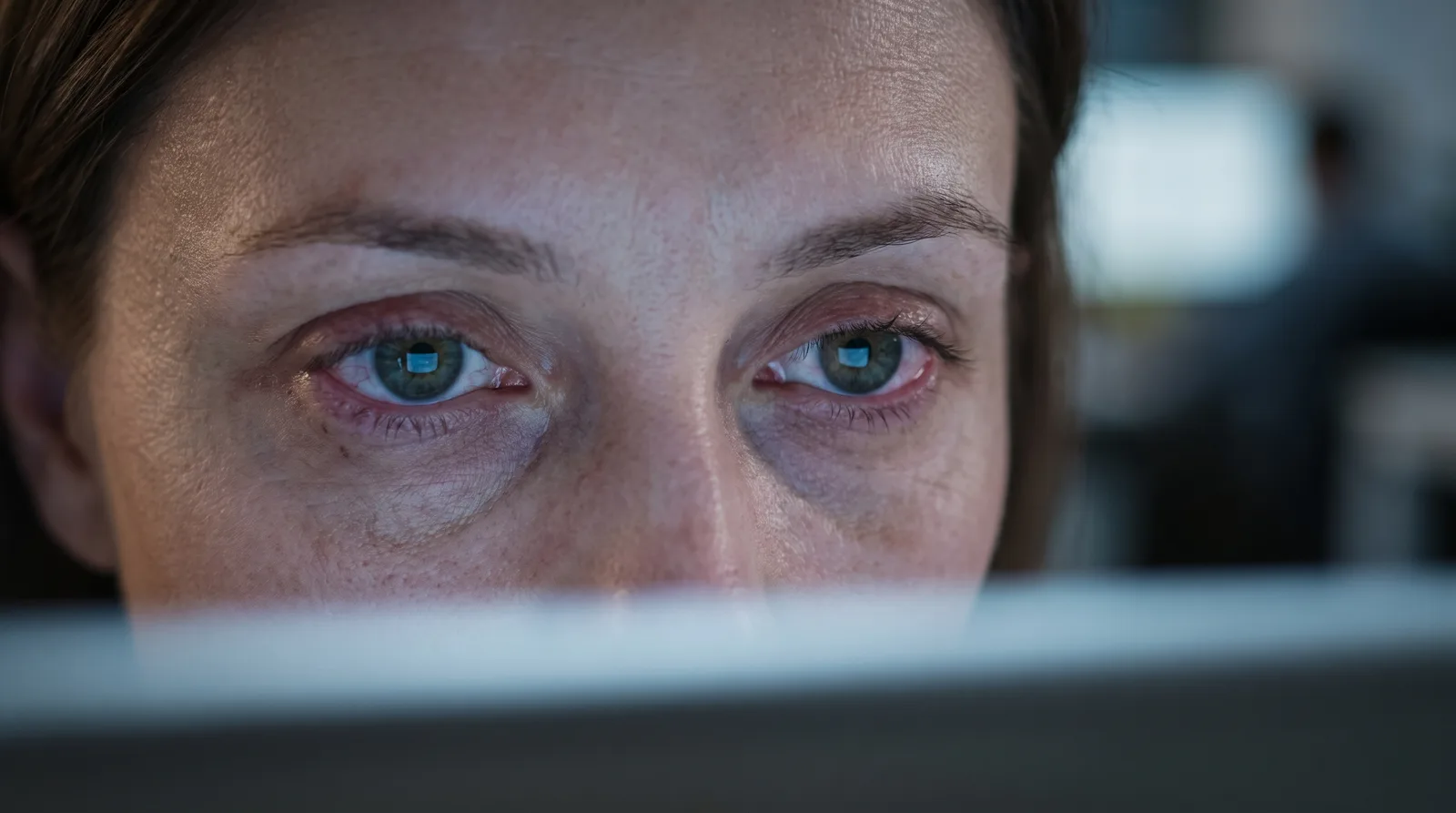
你知道那種感覺。傍晚時分,你從螢幕上抬起頭,眼睛感覺像是被人換成了兩片乾掉、又在沙子裡滾過的隱形眼鏡。你用力眨了幾下,視線恢復清晰,然後又回去工作。這整套小小的儀式是有原因的,而且原因簡單到近乎好笑:在你鎖定螢幕的那一刻,你幾乎就停止眨眼了。
你的眨眼次數直接墜崖
在放鬆狀態下,你每分鐘會眨眼大約 15 到 22 次,完全不必去想它。然後你把焦點放到螢幕上——它就崩盤了。那個經典的觀察量到,在螢幕前,眨眼掉到大約每分鐘 7 次,而放鬆時是 22 次(Tsubota & Nakamori, 1993)。其他研究測到使用螢幕時大約有五倍的下降(Patel et al., 1991),而針對電腦使用者的研究則常常落在每分鐘 11 到 12 次左右(Portello et al., 2013)。不論你採用哪個數字,方向都是一樣的,而且三十年來被各個獨立團隊反覆重現:盯著看,大約會讓你的眨眼減半。
它還更陰險。問題不只是你眨得比較少——你好不容易眨出來的那些,還有更多是不完全的,眼皮從來沒有完全閉合。事實證明,這一點和眨眼的原始次數一樣重要(Portello et al., 2013),而螢幕似乎特別會把不完全眨眼的比例推高(Argilés et al., 2015; Himebaugh et al., 2009)。
為什麼這會把你的眼睛變成砂紙
每一次完整的眨眼都是一支雨刷:它重新鋪好那層讓你的眼睛保持滑順、舒適又清晰的淚膜。眨得少——或者眨得不完全——那層膜就會失去穩定、乾涸,並且一塊一塊地破裂。根據那份大型的國際共識報告,正是這種不穩定本身,就是乾眼症背後的核心機轉(Craig et al., 2017),而它也是所謂數位眼睛疲勞、或電腦視覺症候群的首要驅動因素:那種乾澀、粗糙、眼睛疲勞,以及那種令人抓狂、時清時糊的模糊。這也很常見——電腦使用者當中,回報有症狀的比例從大約一半到 90% 都有(Rosenfield, 2011)。
所以下午五點的那種砂紙感並不神祕,它也不是「螢幕輻射」或網路上任何更玄的理論。它只是一支停止擦拭的雨刷。
那個有名的「20-20-20 法則」能解決它嗎?
你大概聽過:每 20 分鐘,看向 20 英尺(約 6 公尺)外的東西 20 秒。它很合理、免費,而且基本上無害——所以儘管去做無妨。只是把你的期待放誠實一點。唯一一項真正直接測試它的研究發現,症狀在人們持續執行的期間有所改善,但這個效益在停止後的一週之內就消退了(Talens-Estarelles et al., 2023)。它是個好習慣,不是解藥——而且這條建議裡更有用的那一半,其實更簡單:記得眨眼,而且要眨完整。

那個嚇人的說法,拆解掉:「螢幕會造成視網膜剝離」
我們得小心處理這一個,因為它被瘋傳,而且以它通常被講述的方式來說,是有誤導性的。盯著筆電看,並不會伸手進去把你的視網膜剝下來。真正的因果鏈更緩慢、也更間接:兒童時期大量的近距離用眼(包括螢幕)與近視——也就是看遠一片模糊——的加深有關(Huang et al., 2015);高度近視會把眼球拉長;而一顆被拉得更長、高度近視的眼睛,確實帶有真正升高的終生視網膜剝離風險(在 −1 到 −3 屈光度時大約 4 倍,超過 −3 時大約 10 倍;Eye Disease Case-Control Study Group, 1993)。
但即使是這個,也需要一個誠實的星號:螢幕使用時間本身在造成近視這件事上,紀錄其實相當分歧——有一篇回顧發現沒有顯著關聯(Lanca & Saw, 2020),另一篇則發現有關聯,但很不牢靠(Foreman et al., 2021)。要記住的重點不是「螢幕會讓你視網膜剝離」。而是「剝離的風險,關乎的是你這一生會變得多近視——一個結構性的、長線的議題——而不是你今天下午盯著試算表這件事,此刻正在對你做什麼」。
什麼時候該去看眼科醫生
一個真正的警訊,所以我們把話講清楚:突然閃現的光、一大片新出現的飛蚊、或視野中有一塊黑幕般的東西移過來,都可能是真正的視網膜剝離的訊號——那是急症,馬上就去。而如果你的眼睛持續乾澀、疼痛,或視力在日常生活中受到影響,請去看驗光師或眼科醫生。一篇部落格文章不等於一次眼睛檢查。
誠實的總結——以及我們的工具在哪裡派得上用場
那個不起眼的真相是:螢幕不會把你的眼睛煎壞,它只是關掉了你的眨眼,而乾澀、疲憊的眼睛就跟著來了。解方同樣不起眼——完整地眨眼、時不時把視線移開,還有別為那些嚇人的迷思恐慌。
這裡我們要對 NeckCure 坦白說。大多數的姿勢與眼睛建議都有同一個缺陷:你沒辦法修正一個你看不見的習慣。你根本不知道你的眨眼次數剛剛暴跌,因為「沒在眨眼」這件事,從你自己內部是看不見的。這正是 NeckCure 的眨眼功能(在 Pro 版中)所要填補的那個特定縫隙——它用你的網路攝影機,量測你工作時實際的眨眼次數,用你自己的數字向你展示,在你鎖定螢幕的那一刻它掉了多少,並輕輕推你一把,提醒你完整地眨眼、並休息一下。它不會治好乾眼症,也不會取代一次眼睛檢查——任何人這樣承諾都是在誇大其詞。它所做的,是讓看不見的變成看得見,好讓上面那些簡單的解方真的發生。有時候,整場戰役的重點就只是察覺而已。
參考文獻
- Tsubota K, Nakamori K (1993). Dry eyes and video display terminalsNew England Journal of Medicine. PMID 8426634DOI 10.1056/NEJM199302253280817The classic observation: blink rate ~22/min relaxed, ~10/min while reading, ~7/min at a screen. A short research letter — treat the exact figures as a landmark observation, not a precise trial.
- Patel S, Henderson R, Bradley L, Galloway B, Hunter L (1991). Effect of visual display unit use on blink rate and tear stabilityOptometry and Vision Science. PMID 1766652Blink rate fell roughly 5-fold during screen use; longer gaps between blinks were linked to tear-film instability.
- Portello JK, Rosenfield M, Chu CA (2013). Blink rate, incomplete blinks and computer vision syndromeOptometry and Vision Science. PMID 23538437DOI 10.1097/OPX.0b013e31828f09a7During computer work, blink rate ~11.6/min and ~16% of blinks were incomplete. Incomplete blinks tracked with symptoms — suggesting HOW you blink matters as much as how often.
- Argilés M, Cardona G, Pérez-Cabré E, Rodríguez M (2015). Blink rate and incomplete blinks in six different controlled hard-copy and electronic reading conditionsInvestigative Ophthalmology & Visual Science. PMID 26517404DOI 10.1167/iovs.15-16967Blink rate dropped in every reading condition, but electronic screens specifically raised the proportion of incomplete blinks.
- Himebaugh NL, Begley CG, Bradley A, Wilkinson JA (2009). Blinking and tear break-up during four visual tasksOptometry and Vision Science. PMID 19156014DOI 10.1097/OPX.0b013e318194e962Demanding visual tasks significantly suppressed blinking and were linked to where the tear film broke up.
- Craig JP, Nichols KK, Akpek EK, et al. (2017). TFOS DEWS II definition and classification reportThe Ocular Surface. PMID 28736335DOI 10.1016/j.jtos.2017.05.008International consensus: dry eye is driven by tear-film instability — the exact thing that reduced, incomplete blinking causes.
- Rosenfield M (2011). Computer vision syndrome: a review of ocular causes and potential treatmentsOphthalmic and Physiological Optics. PMID 21480937DOI 10.1111/j.1475-1313.2011.00834.xReviews digital eye strain; symptom rates commonly reported at 64–90% of computer users, with dry eye / blink disruption a leading cause.
- Talens-Estarelles C, Cerviño A, García-Lázaro S, Fogelton A, Sheppard A, Wolffsohn JS (2023). The effects of breaks on digital eye strain, dry eye and binocular vision: testing the 20-20-20 ruleContact Lens and Anterior Eye. PMID 35963776DOI 10.1016/j.clae.2022.101744The closest direct test of 20-20-20: symptoms improved while people followed it, but the benefit faded within a week of stopping. Helpful, but keep expectations grounded.
- Huang HM, Chang DST, Wu PC (2015). The association between near work activities and myopia in children — a systematic review and meta-analysisPLoS ONE. DOI 10.1371/journal.pone.0140419More near work was associated with higher odds of myopia in children (OR 1.14). Observational — association, not proof.
- Lanca C, Saw SM (2020). The association between digital screen time and myopia: a systematic reviewOphthalmic and Physiological Optics. PMID 31943280DOI 10.1111/opo.12657Important counterweight: pooled screen-time-alone and myopia was NOT significant (OR 1.02). The screen-time evidence is genuinely mixed.
- Foreman J, Salim AT, Praveen A, et al. (2021). Association between digital smart device use and myopia: a systematic review and meta-analysisThe Lancet Digital Health. PMID 34625399DOI 10.1016/S2589-7500(21)00135-7Found an association between smart-device use and myopia, but with high heterogeneity — interpret cautiously.
- The Eye Disease Case-Control Study Group (1993). Risk factors for idiopathic rhegmatogenous retinal detachmentAmerican Journal of Epidemiology. PMID 8484366The real detachment link is myopia DEGREE: −1 to −3 D carried ~4× risk, and greater than −3 D ~10× risk. A lifelong structural risk, not a live screen effect.