Muscle Imbalance
Why do you slouch? The quiet tug-of-war happening in your own muscles
You don't decide to hunch. Your body drifts there on its own, thanks to a lopsided tug-of-war between muscles that got tight and muscles that got weak. Here is the mechanism behind the slump, why modern life keeps feeding it, and the honest news that it can be retrained.
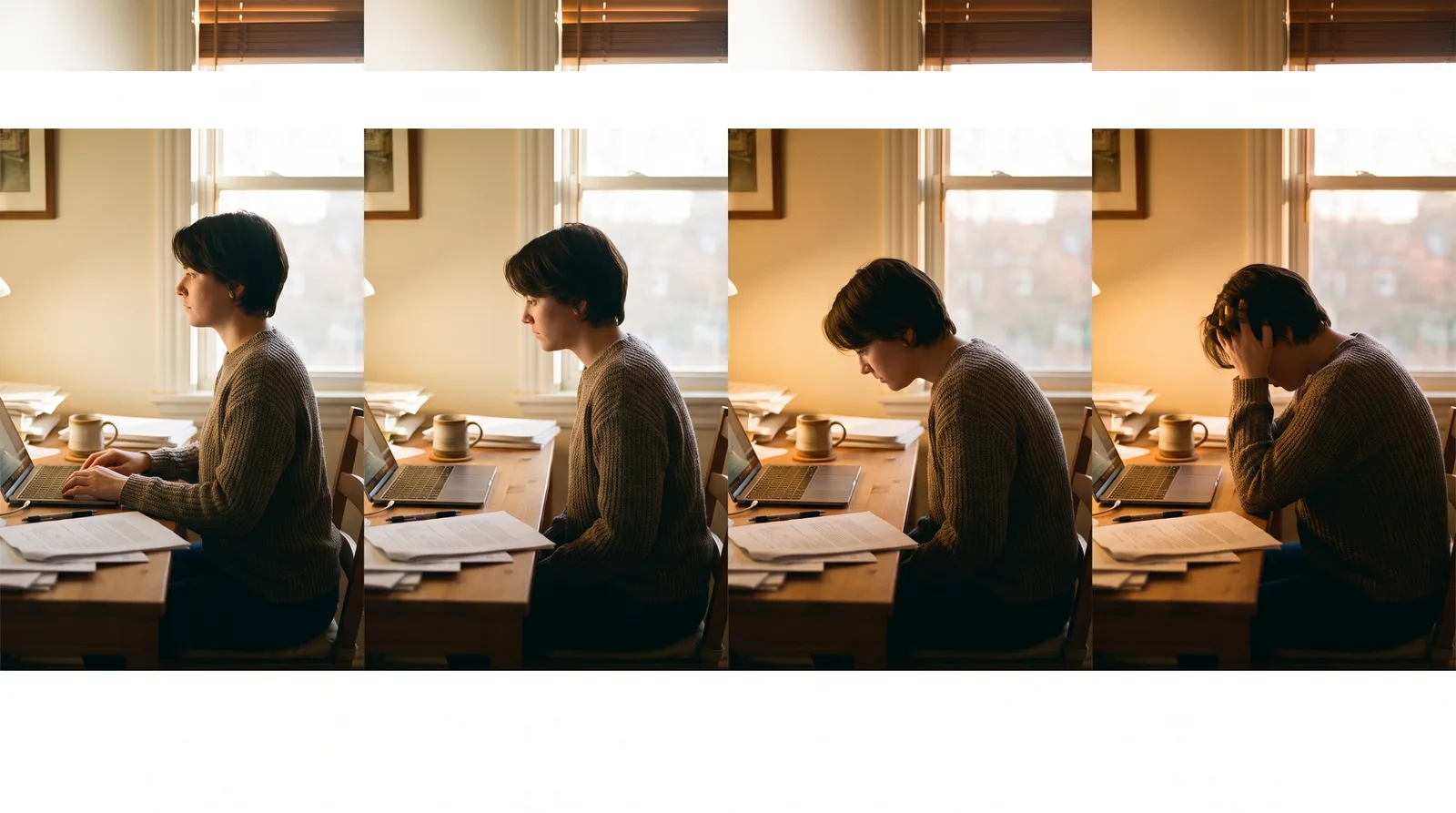
Notice something the next time you catch yourself hunched over a laptop: you never decided to do it. You didn’t think “I shall now collapse my chest and shove my head forward.” You sat down straight-ish, got absorbed, and twenty minutes later your body had quietly folded itself into a slump without asking. Slouching isn’t a choice you make. It is something that happens to you.
So why? Why does the body drift toward the hunch, again and again, all on its own? The answer is a small, lopsided tug-of-war going on inside your own muscles, and once you see it, the whole thing makes sense, including why willpower alone never seems to fix it.
The tug-of-war: some muscles get tight, others get weak
Your upright posture is held by a balance of muscles pulling in opposite directions. The ones on the front and the ones on the back have to share the job evenly. Slouching is what happens when that balance goes lopsided, and it goes lopsided in a very predictable way.
Back in the 1980s, a Czech physician named Vladimir Janda described the pattern so neatly that we still teach it by his name: upper crossed syndrome. A recent review lays it out (Russin et al., 2026). Picture two lines crossing on the side of your upper body:
- On one diagonal, some muscles get tight and overactive: the muscles across your chest (which haul your shoulders forward), and the muscles at the back of your neck and top of your shoulders (which tip your head back to peer up while it juts forward).
- On the other diagonal, the opposing muscles get weak and switched-off: the deep muscles at the front of your neck (which should hold your head stacked over your shoulders), and the muscles between and below your shoulder blades (which should hold your shoulders back and down).
Tight in front and up top, weak in the deep front and lower back. The two overpowered diagonals win the tug-of-war, and the result is the exact shape you know: head forward, shoulders rounded, upper back humped. You’re not slouching because you’re lazy. You’re slouching because half your postural muscles are quietly outmuscling the other half.
Why modern life feeds it perfectly
Here is the part that makes it an epidemic. This imbalance is built by what you do all day, and what we all do all day is lean into a screen. Every hour with your arms reaching forward to a keyboard and your head tipped down to a phone is an hour spent shortening the front and stretching the back, training exactly the lopsided pattern above.
The phone is the sharpest version. The sustained head-down posture even earned a nickname, text neck, and heavy smartphone use tracks right along with it (Sureshbabu et al., 2025). Your body is doing what bodies do: adapting to the position you hold most. It’s just that the position you hold most, these days, is a hunch.
Why it is worth undoing (kept honest)
Left alone for decades, that adaptive slump can slowly set into structural curvature, and that end of the spectrum isn’t trivial: a large study found older adults with a markedly hunched posture had about 1.4 times higher mortality than their straighter-backed peers (Kado et al., 2004).
But read that carefully, because it is easy to misuse. The hunch in that study is the structural, age-related curvature often tied to weakened, fractured vertebrae, not the temporary slump you’re in right now, and it’s an association, not proof that slouching shortens your life. It’s a reason to protect the upright spine over a lifetime, not a scare story about this afternoon. We would rather give you the honest version than a frightening one.
The genuinely good news: the pattern is trainable
Here is why the mechanism matters so much: because if slouching is a learned muscle imbalance, then it can be un-learned. And unlike a lot of posture folklore, this part has real trials behind it.
When you deliberately train the weak side of the tug-of-war, strengthening the deep neck muscles and the lower shoulder-blade muscles, while loosening the tight side, the balance shifts back. A 2025 randomized controlled trial (Argyrou et al.) using a motor-learning exercise program produced a measurable, lasting improvement in head posture, around 7.5 degrees. A 2025 systematic review (Norasteh et al.) found that retraining those deep neck muscles reliably improves your ability to sense and control where your head is. In plain terms: you can teach the switched-off muscles to switch back on, and teach your body a new default.
The honest part
Two caveats, because this topic collects overstatement. First, “upper crossed syndrome” is a useful clinical model, not a formal disease, and researchers still debate its edges. Second, and importantly: a forward head does not automatically mean pain. Plenty of people carry some slouch and feel perfectly fine, and posture is only one thread in the tangle of what causes neck and back pain. So don’t catastrophize a hunch. The right frame isn’t “my posture is broken”, it’s “my muscles have adapted to what I do, and they can adapt back.”
So how do you actually do it?
Two levers, both free. Break the training. The imbalance is built by hours held in the slump, so interrupt them: get up, roll your shoulders back, lift your head over your spine, and open your chest often, ideally every half hour or so. And feed the weak side: gentle chin-nods that wake up the deep neck muscles, and squeezing your shoulder blades down and back to switch on the muscles that hold you tall. You are not forcing a rigid pose, you are casting votes for the other side of the tug-of-war.
Right now, as you finish this line, do the smallest version: draw your head back over your shoulders and let your chest open. Feel which muscles had gone to sleep.
The bottom line (and where we fit)
You slouch because your body quietly drifted into a muscle imbalance that modern life rehearses all day long, tight in front, weak in the deep back, head drifting forward. It’s not a character flaw and it’s not permanent. It’s a learned pattern, and learned patterns can be retrained.
The catch is that the fix depends on catching the slump often enough to vote the other way, and that is the one thing a busy, screen-absorbed brain is terrible at. That is the narrow job NeckCure does: it uses your webcam to notice the moment your head creeps forward and your back rounds, and nudges you to reset, so you rack up far more of those small upright corrections across a day than you ever would on memory alone. It can’t do your chin-nods for you, and it won’t diagnose or treat a structural spinal condition. It just keeps tapping you back toward the winning side of your own tug-of-war.
(This is a popular article about posture and muscle balance, not medical advice, and no substitute for a diagnosis from a health professional. If you have persistent neck or back pain, a visible spinal curve, or any other symptom, please consult a qualified professional.)
References
- Russin NH, Robertson C, Montalvo A (2026). Upper Crossed Syndrome in the Workplace: A Narrative Review with Clinical Recommendations for Non-Pharmacologic ManagementInternational Journal of Environmental Research and Public Health. PMID 41595914DOI 10.3390/ijerph23010120The mechanism. Reviews Janda's upper crossed syndrome: tight chest and upper-neck muscles cross with weak deep neck flexors and lower shoulder-blade muscles, producing forward head and rounded shoulders.
- Sureshbabu D, Rajalakshmi R, Prakash P, Vasipalli SS (2025). Text Neck and Its Association With Cardiac Autonomic Function, Smartphone Addiction, and Psychophysiological Status in Young AdultsCureus. PMID 40421338DOI 10.7759/cureus.83025Why now. Heavy smartphone use is tied to text neck, the sustained head-forward, flexed posture that trains the imbalance in the first place.
- Kado DM, Huang MH, Karlamangla AS, Barrett-Connor E, Greendale GA (2004). Hyperkyphotic posture predicts mortality in older community-dwelling men and women: a prospective studyJournal of the American Geriatrics Society. PMID 15450042DOI 10.1111/j.1532-5415.2004.52458.xWhy it is worth undoing, with a caveat. Older adults with a markedly hunched posture had about 1.4x higher mortality. This is structural age-related curvature and an association, not proof that a desk slouch shortens life.
- Argyrou S, Kitixis P, Dimitriadis Z, Christakou A, Strimpakos N, Paras G, Tsioutsoumaka M, Kapreli E (2025). The Effectiveness of an Exercise Program Based on Motor Learning Principles for the Correction of the Forward Head Posture: A Randomized Controlled TrialBrain Sciences. PMID 40867204DOI 10.3390/brainsci15080873The good news. Targeted exercise produced a measurable, retained improvement in head posture, about 7.5 degrees of craniovertebral angle. The pattern is trainable.
- Norasteh AA, Karimi K, Faraji S, Ejlali F, Alghosi M, Alimoradi M, Zarei H (2025). Exercise therapy to improve cervical proprioception in individuals with asymptomatic forward head posture: A systematic review of randomized controlled trialsPLoS One. PMID 40966220DOI 10.1371/journal.pone.0330665Systematic review of RCTs: retraining the deep neck muscles improves the sense and control of head position, the very thing that keeps the imbalance in place.