Vedic Wisdom
2,500 years ago, India's oldest scriptures already told you to sit with an erect spine
Long before the ergonomic chair, India's most ancient sacred texts had a single, insistent instruction for anyone who wanted to sit and think: hold the spine erect. They imagined it as the axis of the whole cosmos. Here's the old idea, and the surprisingly solid modern reasons not to slouch.
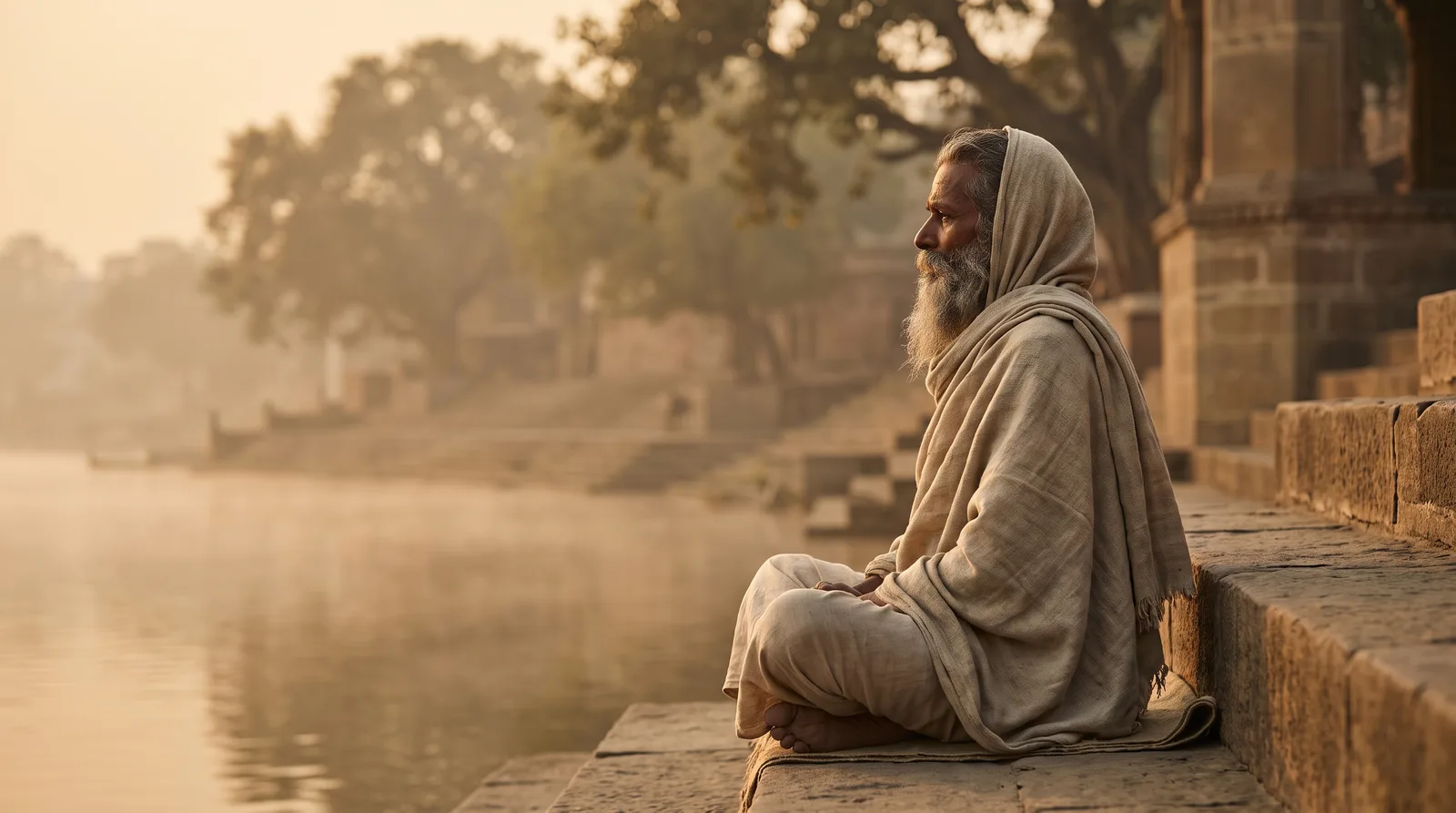
Picture a forest in northern India, roughly 2,500 years ago. Before dawn, a teacher settles down on the riverbank to meditate, and the very first thing he does, before a single breath of the practice, is straighten his spine. He was following an instruction already written into some of the oldest sacred texts humanity has: the Upanishads, the philosophical poems at the tail end of the Vedas (the ancient scriptures at the root of Indian religion). Their advice for anyone who wanted to sit and think was blunt and physical. Sit up. Hold the spine erect.
This article starts with that strange, beautiful old idea, that the upright spine is the axis of the cosmos, and then gets to the part you can actually use: the modern, measured reasons not to slouch.
The ancient idea: the spine as the world’s axis
The instruction is remarkably specific. The Shvetashvatara Upanishad (a Vedic-era text, roughly 2,400 years old) tells the meditator to hold the body steady “with the three upper parts, the chest, neck and head, held erect” (samam), drawing the restless senses inward toward the heart. That’s one of the oldest explicit posture cues on record: not “sit however,” but keep the trunk tall.
Centuries of teachers repeated it. The Bhagavad Gita (the famous “Song of the Lord,” a later Sanskrit scripture around 2,100 years old) gives the same order almost word for word: “hold the body, head and neck straight (samam) and steady, motionless.” Same posture, same word for “erect.”
Why did an upright spine matter so much? Because these thinkers imagined the body as a landscape with a central channel running up its core. The Katha Upanishad put the seed of the idea into a single line: “There are a hundred and one channels of the heart; one of them leads up to the crown of the head.” That single vertical channel, later traditions named it the sushumna (the central “nadi,” or subtle channel, imagined running up the spine), became the spiritual superhighway of Indian yoga.
And here is the poetry of it. In yogic thought the spine even got its own cosmic name: the merudanda, the “staff of Mount Meru.” Mount Meru is the mythic golden mountain that Indian, and Buddhist, cosmology places at the very center of the universe, the axis mundi, the pole around which everything turns. To call your spine the merudanda is to say: the same axis that holds up the cosmos runs up the middle of you. Sit up straight, and you align yourself with the pole of the world.
It’s a gorgeous image. Now let’s be honest about what it is, and get to why sitting up actually pays off.
The payoff: what an erect spine really does
The ancients couldn’t measure blood pressure or lung strength. They worked from observation and metaphor. But strip the cosmology away, and the practical claim underneath, an upright body is a better body to sit in, is one that modern research has quietly been confirming, one piece at a time.
The ancients implied calm and clarity. Modern research finds a mood lift. The whole point of the erect-spine instruction was to steady the mind for meditation, to gather a scattered person into a composed one. That turns out to be measurable. In a randomized trial, people guided into an upright posture reported higher self-esteem, better mood, and less fear under stress than people left to slump (Nair et al., 2015). The old texts used posture to settle the mind; the lab found that sitting tall genuinely nudges how you feel.
The ancients implied vitality and long life. Modern research finds a link with longevity, carefully. The upright spine was, to these traditions, the posture of a person still full of life. There’s a sobering modern echo: a study following more than a thousand older adults found that those with a markedly hunched posture had about a 1.4 times higher death rate (Kado et al., 2004). But here’s the honest caveat, and it matters: that’s the structural curvature of old age, often tied to bone loss and fractures. It’s an association, not proof that slouching at your desk shortens your life. The hunch there is more likely a signal of underlying frailty than its cause. Read it as a nudge, not a threat.
The ancients implied the breath flows better upright. Modern research finds exactly that. Breath, prana in the tradition, was central to this whole practice, and the erect posture was meant to let it move freely. This one is beautifully concrete. When researchers measured the same young men sitting upright versus slouched, respiratory-muscle strength was measurably lower when they slumped (Albarrati et al., 2018). Collapse your torso and you fold up the very muscles that drive your breathing. Sit tall and you literally give your lungs more room to work. On this point the old intuition and the modern measurement shake hands.
The honest part: what’s tradition, and what’s real
Now the part we owe you. The soaring cosmology, the chakras (the wheel-like energy centers strung along the spine), the nadis and the sushumna, the flow of prana, the spine as Mount Meru’s axis, is exactly that: a spiritual and symbolic map, not proven anatomy or medicine. An erect spine does not channel a mystical energy up to your crown, and it does not cure disease.
And one correction worth making plainly, because it’s often gotten wrong: the elaborate chakra system is not in the ancient Vedas at all. It’s a much later development, mostly medieval Tantric and Hatha yoga texts from well over a thousand years after the Upanishads. The old scriptures gave us the simple, powerful instruction, sit erect, and the single central-channel image. The seven glowing wheels came centuries afterward. When someone tells you the ancient Vedic sages mapped your chakras, that’s a lovely story stitched together from different eras.
So what actually holds up? Not the metaphysics, but the posture cue wrapped inside it. A tall, aligned spine really does travel with better breathing, steadier mood, and, in old age, a body that has held together. The sages were right about the sitting even where the cosmology was, let’s say, more poem than physiology.
So how do you actually do it?
The instruction is 2,500 years old and still free. Sit as those texts describe: let the three upper parts, chest, neck and head, stack straight and level. Imagine a fine thread running up your merudanda and out through the crown of your head, gently lengthening the whole column. Let the shoulders drop, not hunch. Breathe into the space you’ve just opened.
You don’t need a forest or a river. You need it most at the one place the ancients never imagined: a desk, where your head drifts forward by the hour and the spine slowly caves. Right now, as you read this, do the ancient thing. Lift the crown of your head and let your spine grow tall.
The bottom line (and where we fit)
Two and a half thousand years ago, before ergonomics was a word, India’s oldest scriptures had already noticed something true: how you hold your spine changes the person sitting in it. They dressed it in the grandest metaphor available, the axis of the cosmos. Peel the metaphor away and the plain observation survives: an upright body breathes better, feels better, and probably ages better. The hard part, then and now, is simply remembering to do it.
That’s the narrow, unglamorous job NeckCure does. It uses your webcam to notice when your head creeps forward and your spine collapses, and quietly nudges you back to tall. It is not yoga, it channels no prana, and it will not align you with Mount Meru. It just helps you spend more minutes of your day in the erect posture that a forest full of ancient sages was already, correctly, insisting on.
(This is a popular article about history, philosophy and posture, not medical advice, and no substitute for a diagnosis from a health professional. If you have back or neck pain or any other symptom, please see a doctor.)
References
- Shvetashvatara Upanishad, 2.8 (-400). Holding the body erect, the three upper parts straight (2.8)Classical Indian Upanishad (Sanskrit), part of the Vedic corpus. SourceOne of the oldest explicit posture instructions: hold the body steady 'with the three upper parts (chest, neck and head) erect', turning the senses toward the heart, for meditation.
- Katha Upanishad, 2.3.16 (-400). The hundred-and-one channels of the heart (2.3.16)Classical Indian Upanishad (Sanskrit), part of the Vedic corpus. Source'There are a hundred and one channels of the heart; one of them leads up to the crown of the head.' The ancient root of the idea of a single central channel running up the body to the crown, later called the sushumna.
- The spine as 'merudanda', the staff of Mount Meru (yogic tradition). The spine as the body's central axis (merudanda)Classical Indian tradition (Sanskrit). SourceIn yogic thought the spine is the 'merudanda', mirroring the mythic Mount Meru, the axis of the cosmos. The upright spine is imagined as the body's world-axis. NOTE: cosmological symbolism, not anatomy.
- Bhagavad Gita, Chapter 6, Verse 13 (-100). Samam kaya-siro-grivam (6.13)Classical Indian scripture (Sanskrit). Source'Hold the body, head and neck straight (samam) and steady, motionless.' A direct instruction to keep the spine erect in meditation.
- Nair S, Sagar M, Sollers J 3rd, Consedine N, Broadbent E (2015). Do slumped and upright postures affect stress responses? A randomized trialHealth Psychology. PMID 25222091The mood payoff. People held upright reported higher self-esteem, better mood and less fear than slumped participants.
- Kado DM, Huang MH, Karlamangla AS, Barrett-Connor E, Greendale GA (2004). Hyperkyphotic posture predicts mortality in older community-dwelling men and women: a prospective studyJournal of the American Geriatrics Society. PMID 15450042DOI 10.1111/j.1532-5415.2004.52458.xThe ageing payoff, with caveats. Older adults with a markedly hunched posture had about a 1.4x higher mortality rate. Caveat: a structural curvature of old age, an association, not proof that slouching shortens life.
- Albarrati A, Zafar H, Alghadir AH, Anwer S (2018). Effect of upright and slouched sitting postures on the respiratory muscle strength in healthy young malesBioMed Research International. PMID 29682532DOI 10.1155/2018/3058970The breathing payoff. Respiratory-muscle strength was measurably lower slouched than upright.