Eyes
Your screen makes you forget to blink, and quietly dries your eyes out
The second you lock onto a screen, your blinking quietly collapses, often by half or more. It's the unglamorous reason your eyes feel like sandpaper by 5pm, and it's the one screen problem you can literally watch happen.
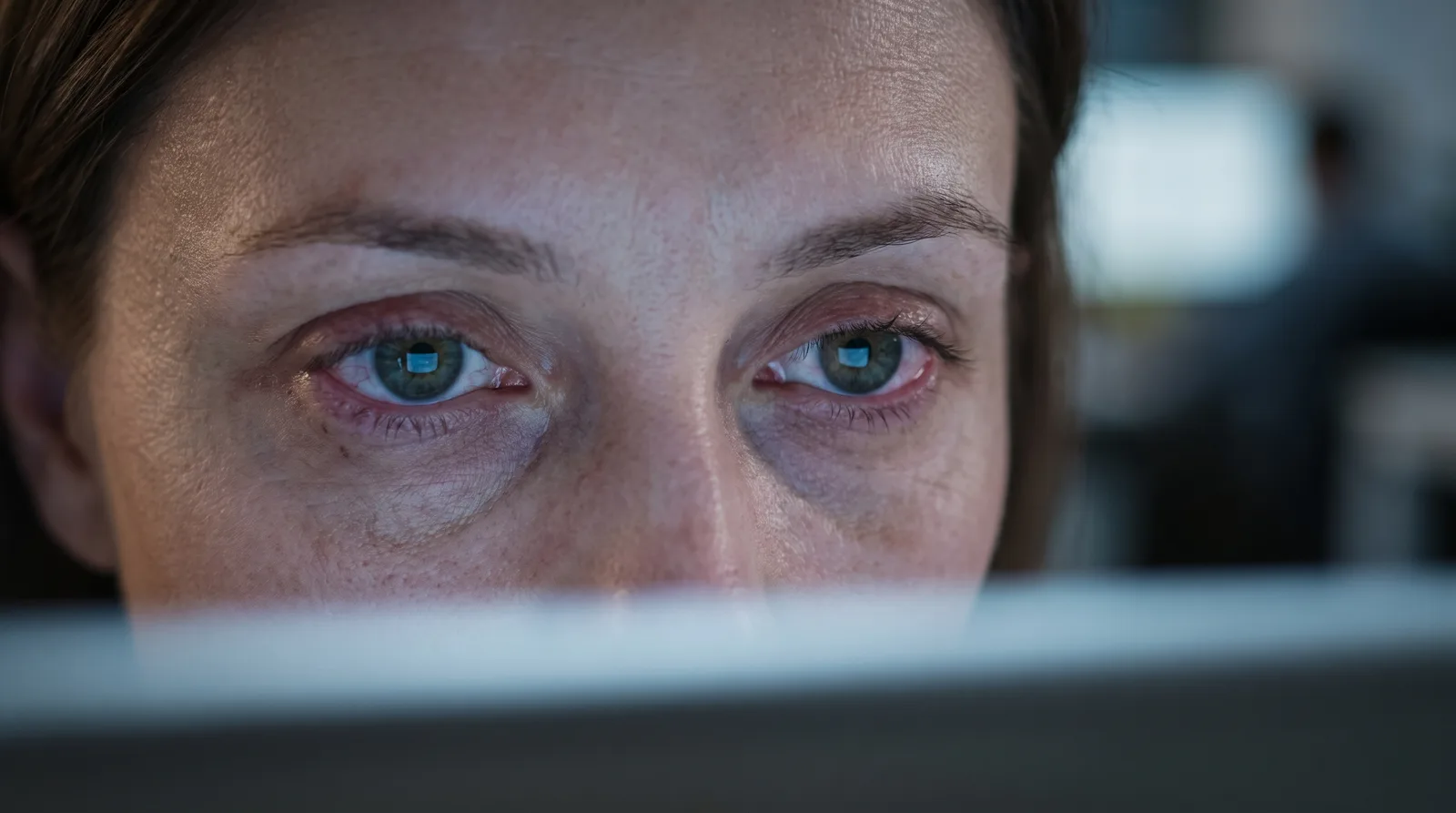
You know the feeling. It’s late afternoon, you look up from the monitor, and your eyes feel like someone swapped them for two dry contact lenses rolled in sand. You blink hard a few times, they clear, and you go back to work. That whole little ritual has a cause, and it’s almost comically simple: the moment you lock onto a screen, you more or less stop blinking.
Your blink rate falls off a cliff
At rest, you blink somewhere around 15 to 22 times a minute without ever thinking about it. Then you focus on a screen, and it collapses. The classic observation clocked it dropping to about 7 blinks a minute at a display, versus 22 relaxed (Tsubota & Nakamori, 1993). Other work measured a roughly five-fold drop during screen use (Patel et al., 1991), and studies of computer users routinely land around 11–12 blinks a minute (Portello et al., 2013). Whichever number you take, the direction is the same and it’s been reproduced by independent teams for thirty years: staring roughly halves your blinking.
It gets sneakier. It’s not just that you blink less; more of the blinks you do manage are incomplete, where the lid never fully closes. That turns out to matter as much as the raw count (Portello et al., 2013), and screens specifically seem to drive incomplete blinking up (Argilés et al., 2015; Himebaugh et al., 2009).
Why that turns your eyes to sandpaper
Every full blink is a windscreen wiper: it resurfaces the tear film that keeps your eyes smooth, comfortable and clear. Blink less, or blink incompletely, and that film destabilises, dries out and breaks up in patches. That instability is the core mechanism behind dry eye, according to the big international consensus report (Craig et al., 2017), and it’s the leading driver of what’s called digital eye strain or computer vision syndrome: the dryness, grittiness, tired eyes and that maddening on-off blur. It’s common, too: symptom rates among computer users are reported anywhere from around half to 90% (Rosenfield, 2011).
So the 5pm sandpaper isn’t mysterious, and it isn’t “screen radiation” or any of the internet’s spookier theories. It’s just a wiper that stopped wiping.
Does the famous “20-20-20 rule” fix it?
You’ve probably heard it: every 20 minutes, look at something 20 feet away for 20 seconds. It’s sensible, it’s free, and it’s basically harmless, so by all means do it. Just keep your expectations honest. The one study that actually tested it head-on found symptoms improved while people kept it up, but the benefit faded within a week of stopping (Talens-Estarelles et al., 2023). It’s a good habit, not a cure, and honestly, the more useful half of the advice is simpler: remember to blink, fully.

The scary claim, defused: “screens cause retinal detachment”
Let’s handle this one carefully, because it gets shared a lot and it’s misleading as usually told. Staring at a laptop does not reach in and detach your retina. The real chain is slower and indirect: heavy near-work in childhood (screens included) is linked to myopia (short-sightedness) progressing (Huang et al., 2015); strong myopia stretches the eyeball; and a more stretched, highly myopic eye carries a genuinely elevated lifetime risk of retinal detachment (roughly 4× at −1 to −3 dioptres, and around 10× beyond −3; Eye Disease Case-Control Study Group, 1993).
But even that needs an honest asterisk: screen time on its own has a genuinely mixed record for causing myopia: one review found no significant link (Lanca & Saw, 2020), another found an association but a shaky one (Foreman et al., 2021). The takeaway isn’t “screens will detach your retina.” It’s “the detachment risk is about how short-sighted you become over a lifetime (a structural, long-game issue), not something your afternoon of spreadsheets is doing to you right now.”
When to see an eye doctor
A real red flag, so we’ll be clear: sudden flashes of light, a shower of new floaters, or a dark curtain moving across your vision can signal an actual retinal detachment: that’s an emergency, go now. And if your eyes are persistently dry, painful, or your vision is affected day to day, see an optometrist or ophthalmologist. A blog is not an eye exam.
The honest bottom line (and where our tool fits)
The unglamorous truth: screens don’t fry your eyes, they just switch off your blinking, and dry, tired eyes follow. The fixes are equally unglamorous: blink fully, look away now and then, and don’t panic about the scary myths.
Here’s where we’ll be straight about NeckCure. Most posture and eye advice has the same flaw: you can’t fix a habit you can’t see. You have no idea your blink rate just cratered, because not-blinking is invisible from the inside. That’s the specific gap NeckCure’s blink feature (in Pro) is built for: it uses your webcam to measure your actual blink rate as you work, shows you in your own numbers how far it drops the moment you lock onto the screen, and nudges you to blink fully and take a break. It won’t cure dry eye disease and it won’t replace an eye exam; anyone promising that is overselling. What it does is make the invisible visible, so the simple fixes above actually happen. Sometimes the whole battle is just noticing.
References
- Tsubota K, Nakamori K (1993). Dry eyes and video display terminalsNew England Journal of Medicine. PMID 8426634DOI 10.1056/NEJM199302253280817The classic observation: blink rate ~22/min relaxed, ~10/min while reading, ~7/min at a screen. A short research letter — treat the exact figures as a landmark observation, not a precise trial.
- Patel S, Henderson R, Bradley L, Galloway B, Hunter L (1991). Effect of visual display unit use on blink rate and tear stabilityOptometry and Vision Science. PMID 1766652Blink rate fell roughly 5-fold during screen use; longer gaps between blinks were linked to tear-film instability.
- Portello JK, Rosenfield M, Chu CA (2013). Blink rate, incomplete blinks and computer vision syndromeOptometry and Vision Science. PMID 23538437DOI 10.1097/OPX.0b013e31828f09a7During computer work, blink rate ~11.6/min and ~16% of blinks were incomplete. Incomplete blinks tracked with symptoms — suggesting HOW you blink matters as much as how often.
- Argilés M, Cardona G, Pérez-Cabré E, Rodríguez M (2015). Blink rate and incomplete blinks in six different controlled hard-copy and electronic reading conditionsInvestigative Ophthalmology & Visual Science. PMID 26517404DOI 10.1167/iovs.15-16967Blink rate dropped in every reading condition, but electronic screens specifically raised the proportion of incomplete blinks.
- Himebaugh NL, Begley CG, Bradley A, Wilkinson JA (2009). Blinking and tear break-up during four visual tasksOptometry and Vision Science. PMID 19156014DOI 10.1097/OPX.0b013e318194e962Demanding visual tasks significantly suppressed blinking and were linked to where the tear film broke up.
- Craig JP, Nichols KK, Akpek EK, et al. (2017). TFOS DEWS II definition and classification reportThe Ocular Surface. PMID 28736335DOI 10.1016/j.jtos.2017.05.008International consensus: dry eye is driven by tear-film instability — the exact thing that reduced, incomplete blinking causes.
- Rosenfield M (2011). Computer vision syndrome: a review of ocular causes and potential treatmentsOphthalmic and Physiological Optics. PMID 21480937DOI 10.1111/j.1475-1313.2011.00834.xReviews digital eye strain; symptom rates commonly reported at 64–90% of computer users, with dry eye / blink disruption a leading cause.
- Talens-Estarelles C, Cerviño A, García-Lázaro S, Fogelton A, Sheppard A, Wolffsohn JS (2023). The effects of breaks on digital eye strain, dry eye and binocular vision: testing the 20-20-20 ruleContact Lens and Anterior Eye. PMID 35963776DOI 10.1016/j.clae.2022.101744The closest direct test of 20-20-20: symptoms improved while people followed it, but the benefit faded within a week of stopping. Helpful, but keep expectations grounded.
- Huang HM, Chang DST, Wu PC (2015). The association between near work activities and myopia in children — a systematic review and meta-analysisPLoS ONE. DOI 10.1371/journal.pone.0140419More near work was associated with higher odds of myopia in children (OR 1.14). Observational — association, not proof.
- Lanca C, Saw SM (2020). The association between digital screen time and myopia: a systematic reviewOphthalmic and Physiological Optics. PMID 31943280DOI 10.1111/opo.12657Important counterweight: pooled screen-time-alone and myopia was NOT significant (OR 1.02). The screen-time evidence is genuinely mixed.
- Foreman J, Salim AT, Praveen A, et al. (2021). Association between digital smart device use and myopia: a systematic review and meta-analysisThe Lancet Digital Health. PMID 34625399DOI 10.1016/S2589-7500(21)00135-7Found an association between smart-device use and myopia, but with high heterogeneity — interpret cautiously.
- The Eye Disease Case-Control Study Group (1993). Risk factors for idiopathic rhegmatogenous retinal detachmentAmerican Journal of Epidemiology. PMID 8484366The real detachment link is myopia DEGREE: −1 to −3 D carried ~4× risk, and greater than −3 D ~10× risk. A lifelong structural risk, not a live screen effect.