Ergonomics
Do ergonomic chairs and standing desks actually work?
The internet will happily sell you a $1,000 chair and a motorised desk to save your back. The evidence is a lot less enthusiastic. Here's what these things really do, what they don't, and the cheap thing that beats both.
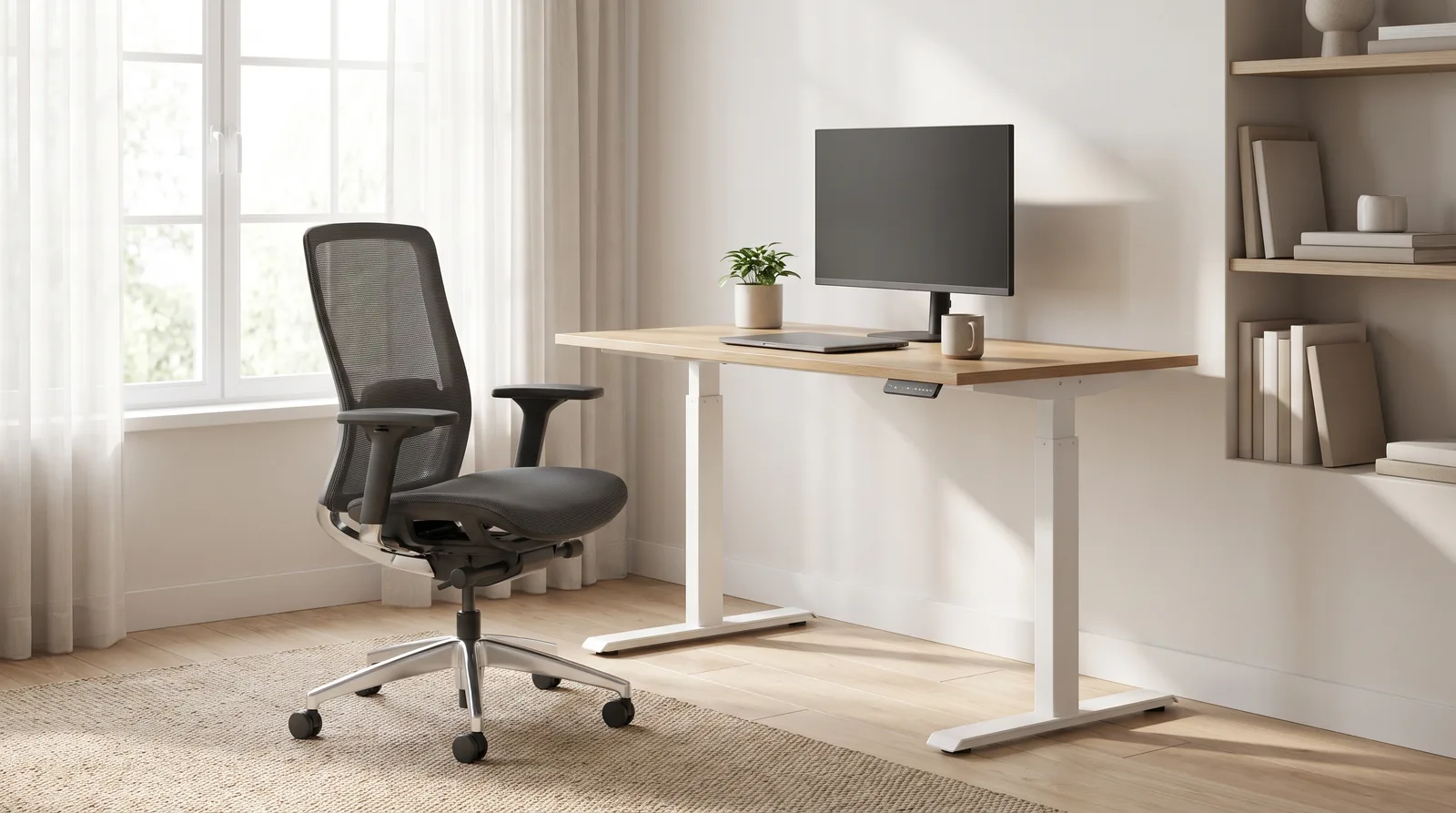
Type “back pain” into any shopping site and a small fortune appears: mesh thrones with nineteen levers, motorised desks that glide from sitting to standing, cushions promising to “realign” you. The pitch is always the same: your body is breaking because you’re sitting wrong, and the right equipment will fix it. It’s a lovely story for anyone selling furniture. The evidence is far grumpier.
The ergonomic chair: helpful, but not the cure it’s sold as
Let’s start with the expensive one. Do ergonomic chairs actually prevent back and neck pain? When researchers pooled the randomised trials, the answer was deflating: ergonomic interventions were no better than doing nothing at preventing back and neck pain (Driessen et al., 2010). Chair studies find some short-term, self-reported relief, but with shaky methods and no idea whether it lasts (van Niekerk et al., 2012). And the most optimistic recent meta-analysis? It found a pain reduction of about 0.28 points on a 10-point scale (statistically real, clinically almost imperceptible) and no improvement in disability at all (Santos et al., 2025).
That’s not “chairs are a scam.” A decent, adjustable chair is pleasant and won’t hurt you. It’s that a chair is not a treatment, and the four-figure price tag is buying comfort and features, not a proven escape from pain.
Lumbar support: it changes your spine, not necessarily your suffering
What about that lumbar bulge everyone swears by? Here’s the neat, slightly humbling science. A lumbar support genuinely does something measurable: it increases the curve in your lower back (though, interestingly, it doesn’t reposition your pelvis) (De Carvalho & Callaghan, 2012). The catch is what that feels like. In one study a lumbar pillow nudged posture closer to “correct” and improved an objective comfort score, yet the people sitting on it reported no difference in how comfortable they actually felt (Grondin et al., 2013). Better posture on paper didn’t translate to a happier back. Support can plausibly lower muscle load (Makhsous et al., 2009), but “my spine is in a nicer shape” and “I feel better” are stubbornly different things.
The standing desk: it reduces sitting, and that’s about all it’s proven to do
Standing desks got a health halo, so let’s be precise about what they’ve earned. The reliable finding: a sit-stand desk cuts how long you sit at work by roughly 100 minutes a day in the short term (Shrestha et al., 2018). Good! But the same Cochrane review rates the evidence that they reduce pain, improve health markers, or boost productivity as low to very low quality. They mostly get you off your chair; they don’t have magic in the standing itself.
And please don’t count standing as exercise: standing burns about 0.15 extra calories a minute over sitting, around 54 calories across a six-hour day (Saeidifard et al., 2018). That’s a single biscuit’s worth of “workout.” Standing all day also isn’t automatically better; it just swaps one static posture for another.
The plot twist: the thing that actually helps is moving

Here’s where the evidence suddenly gets enthusiastic, and it’s not about equipment at all. In the best-designed study of the bunch, office workers given a cushion that kept them gently shifting and moving while seated had dramatically less new pain over six months: neck pain dropped to 15% (versus 65% in the control group) and low-back pain to 10% (versus 59%) (Channak et al., 2024). The winning ingredient wasn’t a posture; it was motion.
That fits the bigger picture perfectly. Prolonged sitting is linked to worse health and higher mortality independent of how much you exercise (Biswas et al., 2015), yet around 60–75 minutes of daily movement can offset even a lot of sitting (Ekelund et al., 2016). Read those together and the verdict is almost rude in its simplicity: the problem was never that your chair wasn’t fancy enough. It’s that you sat still for too long.
So how should you actually spend your money (and effort)?
- A decent adjustable chair is worth having: set the height so your feet are flat and your screen’s at eye level. Just don’t expect it to cure anything.
- A standing desk is fine if it gets you moving: use it to alternate, not to stand rigidly for eight hours.
- Spend most of your effort on motion, not gear. Get up every 20–30 minutes, fidget, shift, take a lap to the kettle. That’s the part with the strongest evidence, and it’s free.
When to see someone
If you have back or neck pain that’s severe, persistent, or worsening, or numbness, tingling, or weakness spreading into a limb, that deserves a proper assessment, not a new chair.
The honest bottom line
Ergonomic chairs and standing desks are comfort tools, not treatments. The chair barely makes a dent in pain, lumbar support changes your posture more than your feelings, and the standing desk’s one proven trick is getting you to sit less. The thing that genuinely protects your neck and back is breaking up the stillness: moving, often.
Which is the entire and only job of NeckCure: it’s not furniture, and it won’t reshape your spine. It just watches for when you’ve frozen into the same position for too long and nudges you to move: the one intervention here the evidence actually cheers for, at roughly none of the price of the chair.
References
- Driessen MT, Proper KI, van Tulder MW, Anema JR, Bongers PM, van der Beek AJ (2010). The effectiveness of physical and organisational ergonomic interventions on low back pain and neck pain: a systematic reviewOccupational and Environmental Medicine. PMID 20360197DOI 10.1136/oem.2009.047548Pooled 10 RCTs: ergonomic interventions were NOT more effective than doing nothing at preventing back or neck pain. The key cold-water finding.
- van Niekerk SM, Louw QA, Hillier S (2012). The effectiveness of a chair intervention in the workplace to reduce musculoskeletal symptoms: a systematic reviewBMC Musculoskeletal Disorders. PMID 22889123DOI 10.1186/1471-2474-13-145Chairs produced some short-term, self-reported symptom relief, but weak randomisation and no long-term follow-up — 'feels better now, unknown later.'
- Santos W, Rojas C, Isidoro R, et al. (2025). Efficacy of ergonomic interventions on work-related musculoskeletal pain: a systematic review and meta-analysisJournal of Clinical Medicine. PMID 40364066DOI 10.3390/jcm14093034Even the optimistic recent meta-analysis (24 RCTs) found only a tiny pain reduction (VAS −0.28) and NO improvement in disability. Small effect, from multi-part programmes — not one pricey chair.
- De Carvalho DE, Callaghan JP (2012). Influence of automobile seat lumbar support prominence on spine and pelvic postures: a radiological investigationApplied Ergonomics. PMID 22280849DOI 10.1016/j.apergo.2011.12.007Lumbar support increases the low-back curve but does NOT change pelvic posture. It reshapes your spine's curve, not your whole sitting position. (Small imaging study, n=8.)
- Grondin DE, Triano JJ, Tran S, Soave D (2013). The effect of a lumbar support pillow on lumbar posture and comfort during a prolonged seated taskChiropractic & Manual Therapies. PMID 23826832DOI 10.1186/2045-709X-21-21A lumbar pillow nudged posture ~2.9° closer to neutral and improved an objective comfort measure — but people did NOT report feeling more comfortable. 'Better posture' ≠ 'feels better.'
- Makhsous M, Lin F, Bankard J, Hendrix RW, Hepler M, Press J (2009). Biomechanical effects of sitting with adjustable ischial and lumbar support on occupational low back painBMC Musculoskeletal Disorders. PMID 19193245DOI 10.1186/1471-2474-10-17An 'off-loading' seat setup lowered back-muscle activity and shifted load off the sitting bones — mechanistically plausible help, but framed as potential, not proven pain relief.
- Shrestha N, Kukkonen-Harjula KT, Verbeek JH, Ijaz S, Hermans V, Pedisic Z (2018). Workplace interventions for reducing sitting at workCochrane Database of Systematic Reviews. PMID 29926475DOI 10.1002/14651858.CD010912.pub4Sit-stand desks cut workplace sitting by roughly 100 minutes/day short-term — but evidence for effects on pain, health and productivity is low-to-very-low quality. Their proven job is 'less sitting,' not 'less pain.'
- Saeidifard F, Medina-Inojosa JR, Supervia M, et al. (2018). Differences of energy expenditure while sitting versus standing: a systematic review and meta-analysisEuropean Journal of Preventive Cardiology. PMID 29385357DOI 10.1177/2047487317752186Standing burns only ~0.15 kcal/min more than sitting — about 54 extra calories over a 6-hour day. Standing is not exercise.
- Channak S, Speklé EM, van der Beek AJ, Janwantanakul P (2024). The effectiveness of a dynamic seat cushion in preventing neck and low-back pain among high-risk office workers: a 6-month cluster-randomized controlled trialScandinavian Journal of Work, Environment & Health. PMID 39169894DOI 10.5271/sjweh.4184The strongest study here. A cushion that kept people gently moving cut new neck pain to 15% (vs 65%) and low-back pain to 10% (vs 59%). Movement beat a static chair.
- Biswas A, Oh PI, Faulkner GE, et al. (2015). Sedentary time and its association with risk for disease incidence, mortality, and hospitalization in adults: a systematic review and meta-analysisAnnals of Internal Medicine. PMID 25599350DOI 10.7326/M14-1651More sedentary time is linked to higher mortality and disease risk — independent of how much you exercise. The problem is the sitting itself. (Observational — association.)
- Ekelund U, Steene-Johannessen J, Brown WJ, et al. (2016). Does physical activity attenuate, or even eliminate, the detrimental association of sitting time with mortality?The Lancet. PMID 27475271DOI 10.1016/S0140-6736(16)30370-1In >1 million people, ~60–75 minutes of daily moderate activity offset the mortality risk of long sitting. The fix is moving, not a fancier way to sit still.