Attraction
Your slouch is talking to your dates before you open your mouth
In a real speed-dating study, one body-language signal nearly doubled the odds of a 'yes', and a slouch is its exact opposite. Here's what your posture broadcasts before you say a word, and the one part of it that's genuinely in your control.
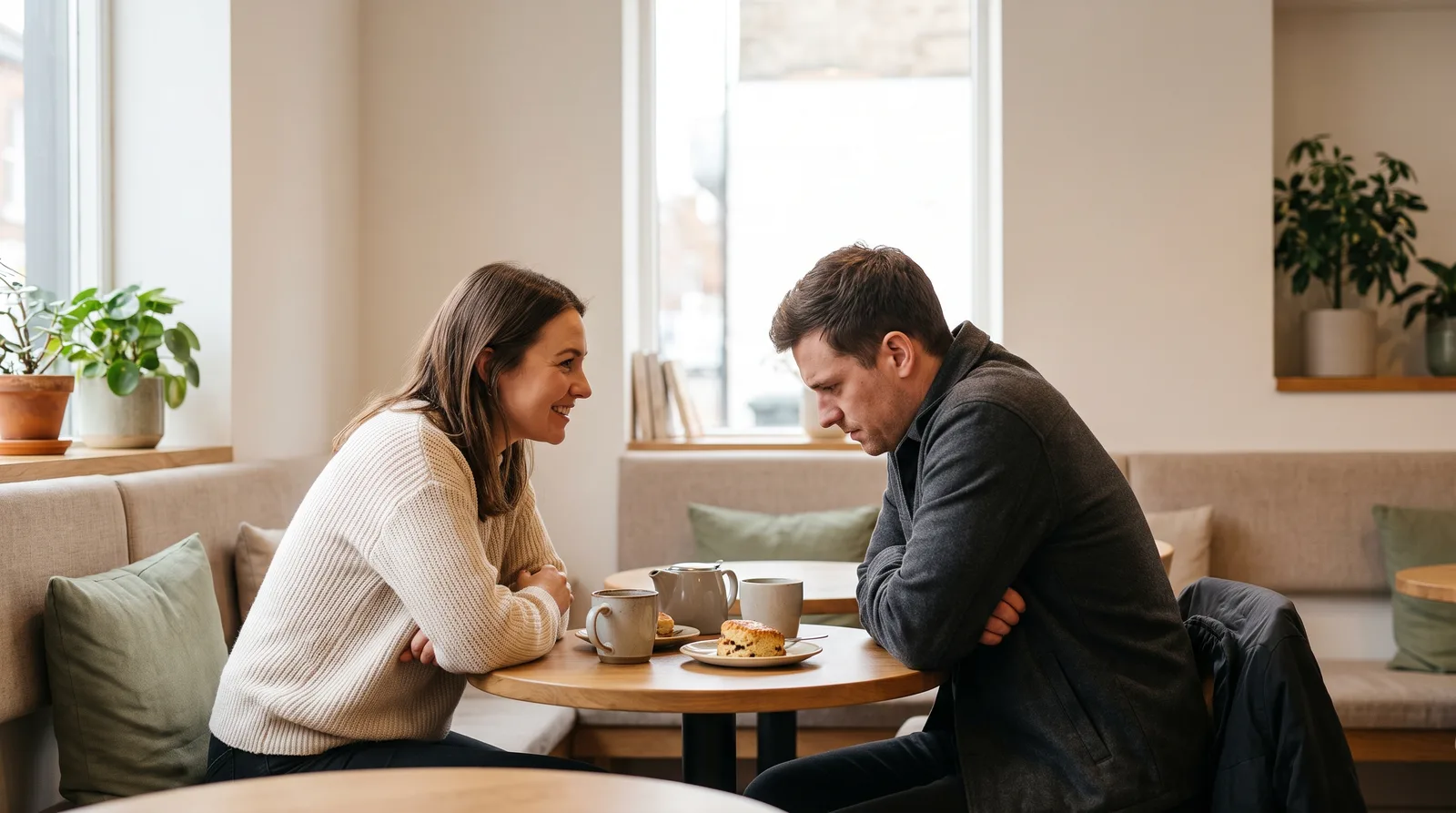
You spent an hour on the outfit. You rehearsed the opening line. And then you sat down, and your body gave a completely different speech: shoulders rounded, chin pushed forward, chest caved in, the universal shape of someone bracing to apologise. Here’s the uncomfortable part. Your date’s brain read that speech before you said a single word. And the research on what a slumped body signals is more brutal than you’d like.
The speed-dating study nobody wants to hear about
Researchers ran a real speed-dating field study and coded everyone’s body language off the video. The single strongest nonverbal predictor of getting a “yes” wasn’t a chiselled jaw. It was postural expansiveness: taking up space, an open chest, limbs uncrossed, the body stretched out rather than folded in. Each step up in openness nearly doubled a person’s odds of a yes (Vacharkulksemsuk et al., 2016). Then they ran it again on a dating app with around 3,000 users, using expansive versus contracted photos of the same people. Same verdict: open bodies got dramatically more hits.
Now flip it around. A slouch is the precise opposite of expansive. It’s contraction: shoulders in, chest collapsed, whole body made smaller. So a slump isn’t neutral. It’s actively broadcasting the losing signal.
Why “taking up space” reads as attractive
The study also found the why: an expansive posture makes you look more dominant and more confident, more like someone who belongs there. At zero acquaintance, when a stranger knows nothing else about you, the body does the talking, and an open one says “comfortable, high-status, worth walking over to.” A folded one mutters the opposite. It isn’t fair. It’s just fast, and it happens before your personality gets a turn.
The part that’s actually in your control
Here’s where it gets genuinely useful, because posture isn’t only about how they see you. It’s about how you feel. In a randomised trial, people taped into an upright posture reported higher self-esteem, a better mood, and less fear under stress than slumped participants, and they even spoke more while focusing less on themselves (Nair et al., 2015). Sitting up straight literally raised how much confidence people placed in their own thoughts about themselves (Briñol et al., 2009). Upright posture even lifted mood and cut fatigue in people with depressive symptoms (Wilkes et al., 2017). So an open posture isn’t just a costume you put on for a date. It quietly tunes the inner state that makes you genuinely more magnetic.
The honest part: put the “power pose” myth down
Now the reality check, because this field has a famous skeleton in the closet. You’ve probably heard that standing in a “power pose” for two minutes floods you with testosterone and drops your cortisol. That came from a real 2010 study, and it did not hold up. A much larger replication found the hormone and risk-taking effects simply weren’t there, only a self-reported feeling of power (Ranehill et al., 2015), and the original claim’s own lead author later publicly disowned it. So don’t strike a superhero pose in the bathroom expecting a chemical high. The real, replicated effect is quieter and honestly better: how you carry yourself changes how you feel and how you read to other people. No hormones required.
And let’s keep it in proportion. Posture is not a love potion, and attraction is a tangle of a hundred things, kindness, humour, timing, luck, actual compatibility. Nobody ever swiped right on a straight spine alone. But of everything on that list, posture is one of the very few levers that’s free, instant, and entirely yours.
When it’s more than a slouch
One caveat worth stating plainly: if you can’t straighten up, if rounding forward is stiff, painful, or fixed no matter how you try, that’s worth a doctor’s look rather than a pep talk. Persistent, rigid upper-back rounding can occasionally point to something structural. Posture you can change is a habit. Posture you can’t is a question for a professional.
The bottom line (and where we fit)
Here’s the thing about a slouch: it isn’t a one-off pose you strike at the table. It’s a shape you rehearse for eight hours a day, folded over a keyboard, chin drifting toward the screen, until your body forgets it has any other default. By the time you walk into the bar, “small and closed” isn’t a choice you’re making in the moment. It’s just the shape you’ve trained.
That’s the narrow thing NeckCure actually does. It uses your webcam to catch the forward-head, caved-chest slump while you work, and nudges you back upright before it hardens into your body’s resting state. It won’t get you a date, write your opener, or fix your love life, and anyone claiming an app can do that is lying to you. What it does is stop you from spending forty hours a week practising the one posture the research says is quietly working against you.
References
- Vacharkulksemsuk T, Reit E, Khambatta P, Kern ML, Eastwick PW, Finkel EJ (2016). Dominant, open nonverbal displays are attractive at zero-acquaintanceProceedings of the National Academy of Sciences (PNAS). DOI 10.1073/pnas.1508932113The headline study. In real speed-dates, postural expansiveness (an open, space-taking body) was the strongest nonverbal predictor of attraction; each step up nearly doubled the odds of a 'yes'. A follow-up dating-app experiment (n=3000) confirmed it causally.
- Nair S, Sagar M, Sollers J 3rd, Consedine N, Broadbent E (2015). Do slumped and upright postures affect stress responses? A randomized trialHealth Psychology. PMID 25222091People randomly taped into an upright posture reported higher self-esteem, better mood and less fear under stress than slumped participants, and spoke more with less self-focus. Posture changes the internal state, not just the look.
- Briñol P, Petty RE, Wagner B (2009). Body posture effects on self-evaluation: a self-validation approachEuropean Journal of Social Psychology. DOI 10.1002/ejsp.607Sitting upright in a confident posture increased the confidence people had in their own thoughts about themselves, compared with a slumped, doubtful posture.
- Wilkes C, Kydd R, Sagar M, Broadbent E (2017). Upright posture improves affect and fatigue in people with depressive symptomsJournal of Behavior Therapy and Experimental Psychiatry. PMID 27494342DOI 10.1016/j.jbtep.2016.07.015An upright posture increased positive affect, reduced fatigue and lowered self-focus in people with mild-to-moderate depressive symptoms. Supporting evidence that posture nudges mood.
- Ranehill E, Dreber A, Johannesson M, Leiberg S, Sul S, Weber RA (2015). Assessing the robustness of power posing: no effect on hormones and risk tolerance in a large sample of men and womenPsychological Science. DOI 10.1177/0956797614553946The honesty check. This large replication found that 'power posing' did NOT change testosterone, cortisol or risk-taking, only self-reported feelings of power. The original claim's own lead author later disavowed it. Don't sell posture as a hormone hack.