Spinal Discs
Do inversion tables and spinal traction really decompress your discs? Sort of, and it does not fix much.
Hang upside down and let gravity pull your spine apart, and your discs decompress. That part is real. The problem is what happens next: the moment you stand up, and what the best trials actually found about traction. Plus the risk nobody mentions.
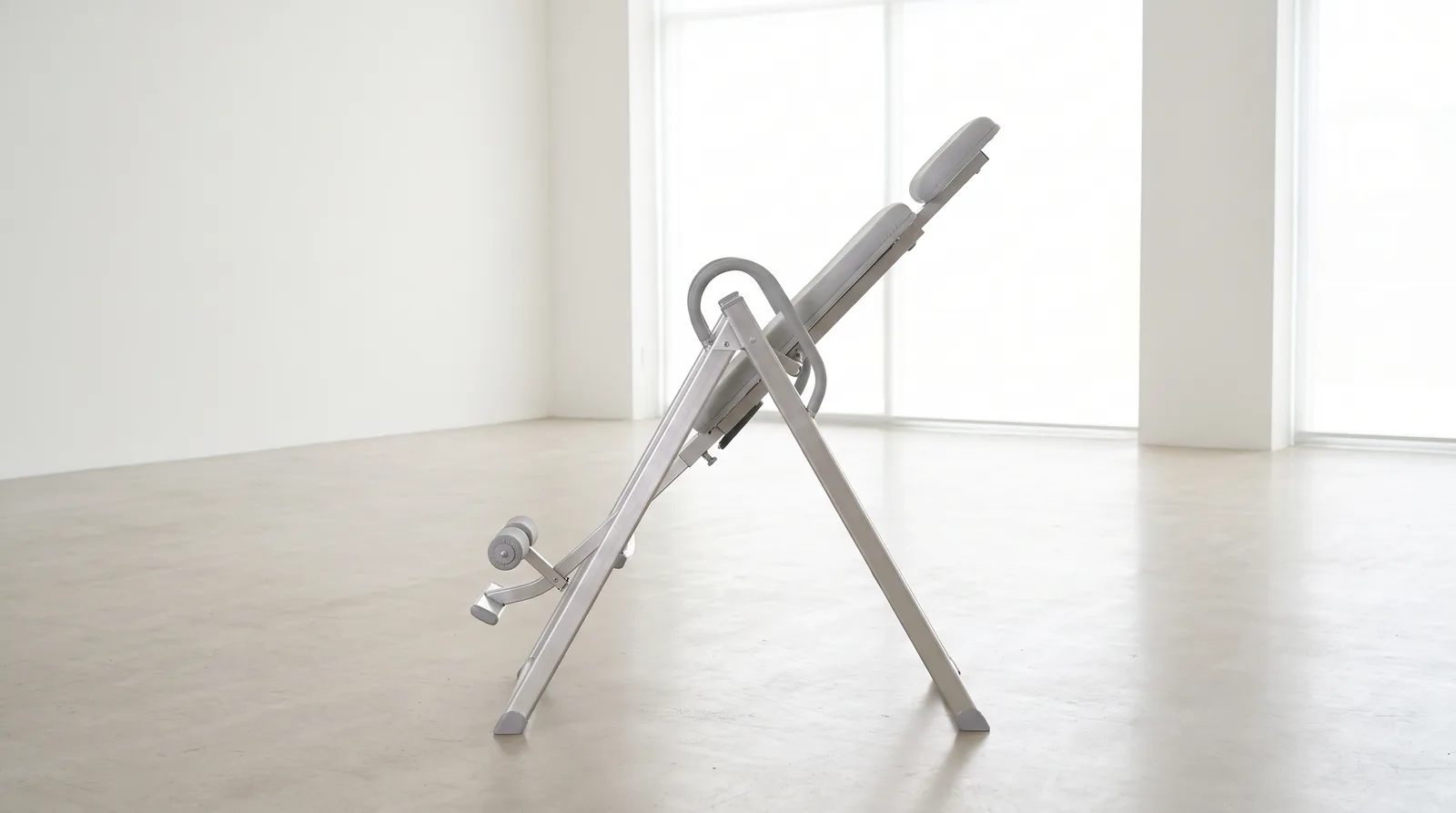
The pitch for an inversion table is pure gravitational logic, and it is genuinely satisfying. Strap your ankles in, tip upside down, and let your own body weight do what a chiropractor’s hands can’t: pull your vertebrae apart, open up the squished discs between them, and let everything breathe. Spinal traction machines sell the same story right-side up, harnessing you and cranking a gentle pull along the spine. Decompress the disc, decompress the pain.
So does it work? The honest answer has two halves that point in opposite directions. Yes, hanging or traction really does decompress a disc while you’re in it. And no, that mostly doesn’t fix the thing you bought it to fix. Both halves are true, and the space between them is where all the marketing lives.
The true half: unloading a disc is real (and you already do it for free)
Start with what’s genuinely true, because it is. Take the compressive load off your spine and the discs really do decompress and take on fluid. We know this cold. When people spend three days in “dry immersion,” a way of floating the body to unload the spine, their lumbar discs swell by around 9.5 percent (Treffel et al., 2016). Traction and inversion are doing a version of the same thing: reducing the squashing force on the disc.
Here’s the part the salesperson leaves out, though. Your body already does this every single night, for free. Lie down to sleep and your discs quietly reabsorb water and regain height, which is exactly why you are measurably taller in the morning than at night (Roberts et al., 1998). Decompression isn’t some exotic effect you need a $300 table to unlock. It’s what a mattress does. So the real question was never “can you decompress a disc?” It’s “does decompressing it, on purpose, on a machine, actually help?”
The other half: the best evidence says it barely moves the needle
This is where the story deflates. Spinal traction is one of the most-studied versions of “pull the spine apart to treat back pain,” and the highest-quality summary is not kind to it. A Cochrane review pooled 32 randomized trials with 2,762 people and concluded that traction makes little or no difference to pain, function, or return to work for low-back pain, with or without sciatica (Wegner et al., 2013). Not “works for some,” not “modest benefit.” Little or no difference, across thousands of patients.
Inversion specifically has thinner evidence, and it’s important to represent it fairly. The result fans point to is a small pilot trial in which fewer people in the inversion group ended up needing surgery for a disc problem (Prasad et al., 2012). That’s a genuinely interesting signal, but read the word pilot: few participants, preliminary, a long way from proof. It is not the banner “inversion cures herniated discs” that gets draped over it.
Why the decompression doesn’t “stick”
The mechanism explains the disappointment. Yes, the disc opens up while you hang, but the instant you stand back up, gravity and muscle tension reload it and it re-compresses, right back to where it was. It’s the same round trip as being tall in the morning and shrinking by evening. You are renting a few millimetres of disc height for a few minutes, not buying them.
And crucially, none of this rebuilds a disc. As we’ve written before, a worn disc has lost the proteoglycan sponge that holds its water; stretching the spine doesn’t restore that any more than drinking water does. Decompression is a temporary mechanical state, not a repair. Pull a degenerated disc apart and it is still, when you let go, a degenerated disc.
The risk nobody puts on the box
Here’s the part that turns this from “harmless but oversold” to “actually be careful.” Hanging upside down is not a neutral act for your body. Inverted and head-down positions raise the pressure inside your eyes, a real hazard for anyone with, or at risk of, glaucoma, and they push up your blood pressure too (Prata et al., 2010). That’s why inversion is widely advised against for people with high blood pressure, heart disease, or glaucoma.
Put it together: inversion is an expensive, occasionally risky way to do temporarily what your bed does for free and safely every night, in the service of an effect that the best trials say doesn’t meaningfully treat back pain. That’s a rough deal.
So what actually helps a cranky disc?
Nothing exotic, which is the recurring theme of this whole topic:
- Move and change position often. The disc trades fluid and nutrients through loading and unloading; gentle, frequent movement is what keeps that going, far more usefully than one dramatic hang.
- Use the free decompression you already have: lying down and sleeping well is the real nightly disc-unloading session, no equipment required.
- Stay active in general. Broad evidence for back health favours ordinary movement and exercise over passive gadgets.
- If a disc problem is real, see a professional. Traction is sometimes used as a short-term, guided symptom tool by clinicians, and that’s fine in context, just don’t mistake it for a cure or self-prescribe hanging upside down if you have the risk factors above.
The bottom line (and where we fit)
Do inversion tables and traction decompress your discs? Technically yes, for as long as you’re on them, which is the same trick your mattress performs nightly. But “decompress the disc for a few minutes” and “fix the disc” are different sentences, and the best evidence says traction lands squarely on the first one. Add the eye-pressure and blood-pressure risks, and hanging upside down looks less like a treatment and more like a gadget with good physics and thin results.
NeckCure sits at the opposite, unglamorous end of this. It won’t decompress, stretch, or repair a disc, and it’s no substitute for a doctor if you have a real disc problem. What it targets is the thing that keeps your discs loaded all day in the first place: the long, static, head-forward slump at a desk. It uses your webcam to catch that and nudge you to move and sit tall, so you spend less of your day pressing down and more of it in the varied, upright posture that actually keeps a spine happy, no ankle straps required.
(This is a popular article about spinal decompression and posture, not medical advice, and no substitute for a diagnosis from a doctor. If you have back or leg pain, a diagnosed disc problem, high blood pressure, heart disease, or glaucoma, please consult a qualified health professional before trying inversion or traction.)
References
- Wegner I, Widyahening IS, van Tulder MW, Blomberg SE, de Vet HC, Bronfort G, Bouter LM, van der Heijden GJ (2013). Traction for low-back pain with or without sciaticaCochrane Database of Systematic Reviews. PMID 23959683DOI 10.1002/14651858.CD003010.pub5The headline evidence. Pooling 32 randomized trials (2,762 people), traction made little or no difference to pain, function, or return to work for low-back pain with or without sciatica.
- Prasad KS, Gregson BA, Hargreaves G, Byrnes T, Winburn P, Mendelow AD (2012). Inversion therapy in patients with pure single level lumbar discogenic disease: a pilot randomized trialDisability and Rehabilitation. PMID 22263648DOI 10.3109/09638288.2011.647231The most-cited point in inversion's favour, kept in proportion. In a small pilot trial, fewer patients in the inversion group progressed to surgery, but it was a pilot, with few participants, not proof of a cure.
- Roberts N, Hogg D, Whitehouse GH, Dangerfield P (1998). Quantitative analysis of diurnal variation in volume and water content of lumbar intervertebral discsClinical Anatomy. PMID 9445091Unloading a disc is normal and free. Lumbar discs regain volume and water overnight simply from lying down, which is why you are taller in the morning. Your body decompresses your spine every single night.
- Treffel L, Mkhitaryan K, Gellee S, Gauquelin-Koch G, Gharib C, Blanc S, Millet C (2016). Intervertebral Disc Swelling Demonstrated by 3D and Water Content Magnetic Resonance Analyses after a 3-Day Dry Immersion Simulating MicrogravityFrontiers in Physiology. PMID 27994557DOI 10.3389/fphys.2016.00605Take the load off a spine and its discs swell, about 9.5% over three days of unloading. Decompression is real, but it is a temporary response to unloading, not a permanent structural repair.
- Prata TS, De Moraes CG, Kanadani FN, Ritch R, Paranhos A Jr (2010). Posture-induced intraocular pressure changes: considerations regarding body position in glaucoma patientsSurvey of Ophthalmology. PMID 20637484DOI 10.1016/j.survophthal.2009.12.002The risk nobody mentions. Head-down and inverted body positions raise the pressure inside the eye, a real concern for anyone with or at risk of glaucoma; inversion also raises blood pressure.