Eyes
Do blue-light glasses actually protect your eyes?
Blue-light glasses are a billion-dollar answer to tired, dry, screen-fried eyes. There's just one problem: the best evidence says they basically don't work. Here's what's really making your eyes ache, and what actually helps.
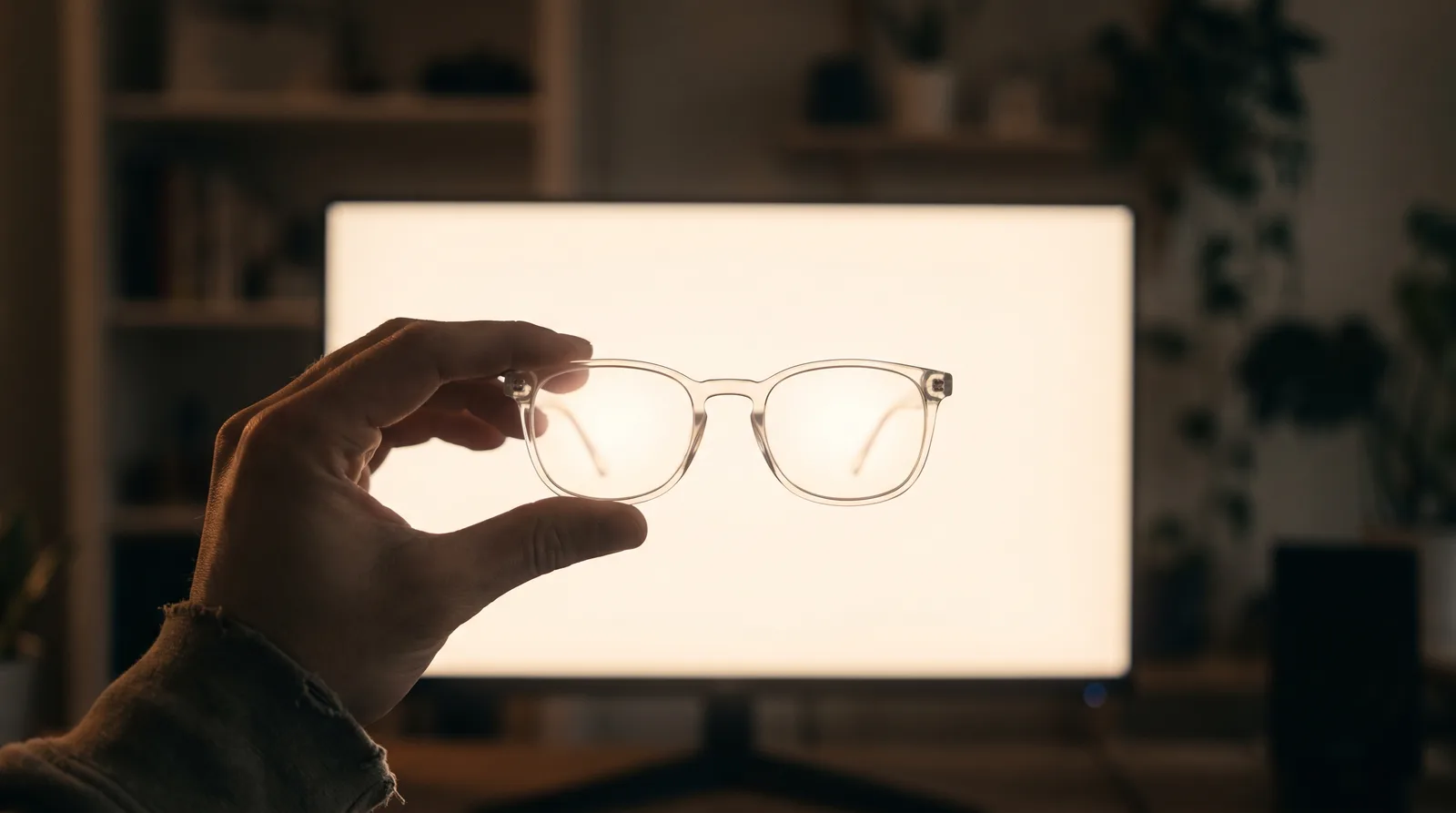
Somewhere in your house, there is probably a pair of blue-light glasses. Maybe you bought them, maybe they came free with an eye test, maybe an ad convinced you at 1 a.m. that the screen was slowly frying your retinas. They’ve become the default answer to a very real problem: eyes that feel dry, gritty, tired and blurry after a day at the screen.
Here’s the awkward part. When scientists actually put blue-light glasses to the test, the evidence for them is close to nothing. And the thing genuinely bothering your eyes is something they don’t even touch.
The myth, meet the biggest study we have
Let’s not tiptoe. In 2023 the Cochrane collaboration (about as rigorous as evidence reviews get) pooled 17 randomised trials of blue-light-filtering glasses. The conclusion was blunt: they probably don’t reduce eye strain from computer use, they make little or no difference to your vision, and there’s no good evidence they protect the macula or improve sleep (Singh et al., 2023). A big review of digital eye strain reached the same shrug: blue-light lenses give “mixed results” at best (Sheppard & Wolffsohn, 2018).
So the glasses aren’t a scandal; they’re just aimed at the wrong villain. Blue light from screens turns out to be a bit player. To fix your eyes, you have to know what’s actually straining them.
What’s really going on: your eyes are dry and over-focused
“Digital eye strain” (the clinical name is computer vision syndrome) is genuinely real and genuinely common: somewhere between half and 90% of computer users get symptoms (Rosenfield, 2011; Sheppard & Wolffsohn, 2018). But it comes from two unglamorous mechanisms, and neither is blue light.
One: your eyes dry out. The moment you lock onto a screen, your blinking collapses, from around 22 times a minute at rest to roughly 7 at a display (Tsubota & Nakamori, 1993). Worse, more of the blinks you do manage are incomplete (the lid never fully closes), and it’s the incomplete blinking that tracks most closely with symptoms (Portello et al., 2013). Each proper blink resurfaces your tear film; skip enough of them and that film destabilises, which is the very core of dry eye (Craig et al., 2017). That’s the sandpaper feeling.
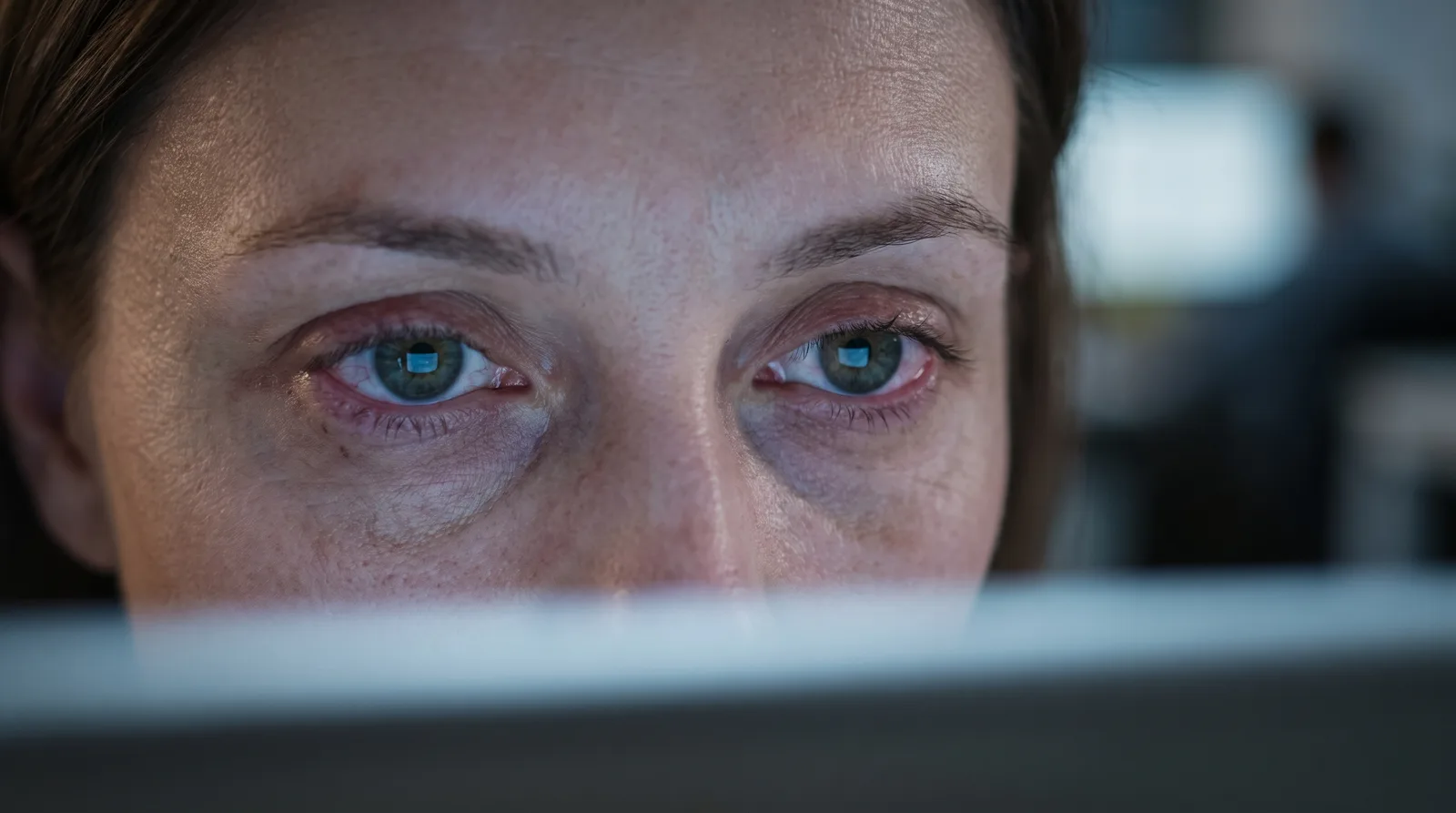
Two: your focusing muscles get tired. Staring at a fixed, close distance for hours keeps the eye’s focusing and alignment system (accommodation and vergence) clenched, and it fatigues: the ache-behind-the-eyes, the moment of blur when you glance up (Rosenfield, 2011). A blue tint does exactly nothing for this.
Put together: dry surface plus tired focusing muscles. That’s the whole story of the 5 p.m. eye-ache, and it’s why a coloured lens can’t rescue it.
What actually helps (all free, all unglamorous)
The good news is the real fixes are simple. The slightly annoying news is that they’re habits, not purchases.
- Blink, fully. Since incomplete blinks are the problem, the fix isn’t just blinking more, it’s letting your eyelids fully close now and then (Portello et al., 2013). Sounds absurd; genuinely helps.
- Take breaks: the 20-20-20 idea. Every 20 minutes, look at something ~20 feet (6 metres) away for ~20 seconds, to let the focusing system relax. The one study that tested it head-on found it eased symptoms while people did it, but the benefit vanished within a week of stopping (Talens-Estarelles et al., 2023). Translation: it works, but only as an ongoing habit.

- Get your prescription checked. An uncorrected or out-of-date prescription (including reading needs after ~40) makes the focusing system work even harder (Rosenfield, 2011). This is one of the most overlooked fixes.
- Fight the dryness. Blinking, regular screen breaks, and (as standard eye-care advice) artificial tears and a less bone-dry room can all ease a parched surface.
Notice what’s not on the list: a blue tint.
When to see an eye doctor
A real note: if your eyes are persistently dry, painful, red, or your vision is genuinely affected day to day, see an optometrist or ophthalmologist. Dry eye is a proper multifactorial condition, and persistent symptoms deserve a diagnosis, not another gadget and definitely not a blog.
The honest bottom line
Blue-light glasses are a tidy product for a problem they don’t solve. The best evidence says they don’t meaningfully reduce eye strain, because the strain comes from a drying tear film and a fatigued focusing system, not from the colour of the light. The fixes that do work are behavioural: blink fully, look away regularly, get your eyes checked.
And that first one is exactly where NeckCure’s blink feature (in Pro) fits: it uses your webcam to show you, in your own numbers, how far your blink rate crashes when you lock onto the screen, and nudges you to blink and take a break. It won’t cure dry eye or replace an eye exam, and we’re not going to pretend a piece of software (or a pair of tinted glasses) does. But if the real problem is that you’ve simply stopped blinking, the first win is noticing. If you want the full story on that blink-crash, we dug into it here.
References
- Singh S, Keller PR, Busija L, McMillan P, Makrai E, Lawrenson JG, Hull CC, Downie LE (2023). Blue-light filtering spectacle lenses for visual performance, sleep, and macular health in adultsCochrane Database of Systematic Reviews. PMID 37593770DOI 10.1002/14651858.CD013244.pub2The centerpiece. A Cochrane systematic review of 17 randomised trials: blue-light lenses probably do NOT reduce eye strain from computer use, make little or no difference to vision, and have no proven effect on sleep or macular health.
- Rosenfield M (2011). Computer vision syndrome: a review of ocular causes and potential treatmentsOphthalmic & Physiological Optics. PMID 21480937DOI 10.1111/j.1475-1313.2011.00834.xBetween 64% and 90% of computer users get eye symptoms. Two real mechanisms: (1) dry eye from reduced blinking, and (2) accommodative/vergence (focusing) fatigue. Note: blue light isn't the cause.
- Sheppard AL, Wolffsohn JS (2018). Digital eye strain: prevalence, measurement and ameliorationBMJ Open Ophthalmology. PMID 29963645DOI 10.1136/bmjophth-2018-000146Digital eye strain affects 50%+ of computer users; symptoms split into focusing-related and dry-eye-related. Concludes blue-light lenses give 'mixed results' for it — consistent with the Cochrane review.
- Craig JP, Nichols KK, Akpek EK, et al. (2017). TFOS DEWS II definition and classification reportThe Ocular Surface. PMID 28736335DOI 10.1016/j.jtos.2017.05.008International consensus: dry eye is a multifactorial disease whose core is loss of tear-film stability — exactly what happens when you stop blinking properly at a screen.
- Portello JK, Rosenfield M, Chu CA (2013). Blink rate, incomplete blinks and computer vision syndromeOptometry and Vision Science. PMID 23538437DOI 10.1097/OPX.0b013e31828f09a7At a computer, blink rate ~11.6/min and ~16% of blinks were incomplete; symptoms tracked with incomplete blinks. Blinking MORE on cue didn't help — blinking FULLY is what matters.
- Tsubota K, Nakamori K (1993). Dry eyes and video display terminalsNew England Journal of Medicine. PMID 8426634DOI 10.1056/NEJM199302253280817Classic early observation that blink rate drops sharply at a screen (~22/min relaxed to ~7/min at a display). A short letter — treat as a landmark observation.
- Talens-Estarelles C, Cerviño A, García-Lázaro S, Fogelton A, Sheppard AL, Wolffsohn JS (2023). The effects of breaks on digital eye strain, dry eye and binocular vision: testing the 20-20-20 ruleContact Lens and Anterior Eye. PMID 35963776DOI 10.1016/j.clae.2022.101744The rare direct test of 20-20-20 (n=29): symptoms eased while people kept it up, but the benefit faded within a week of stopping. Helpful as a habit, not a cure.