Chinese Medicine
2,000 years ago, Chinese medicine already read your slouch like a diagnosis
Two millennia before the X-ray, China's oldest medical classic was reading how you hold your body as a report on your health. Its verdict on a bent back was blunt: 'the residence is failing.' Here's what the old texts said about the spine, and how much of it modern research has since caught up to.
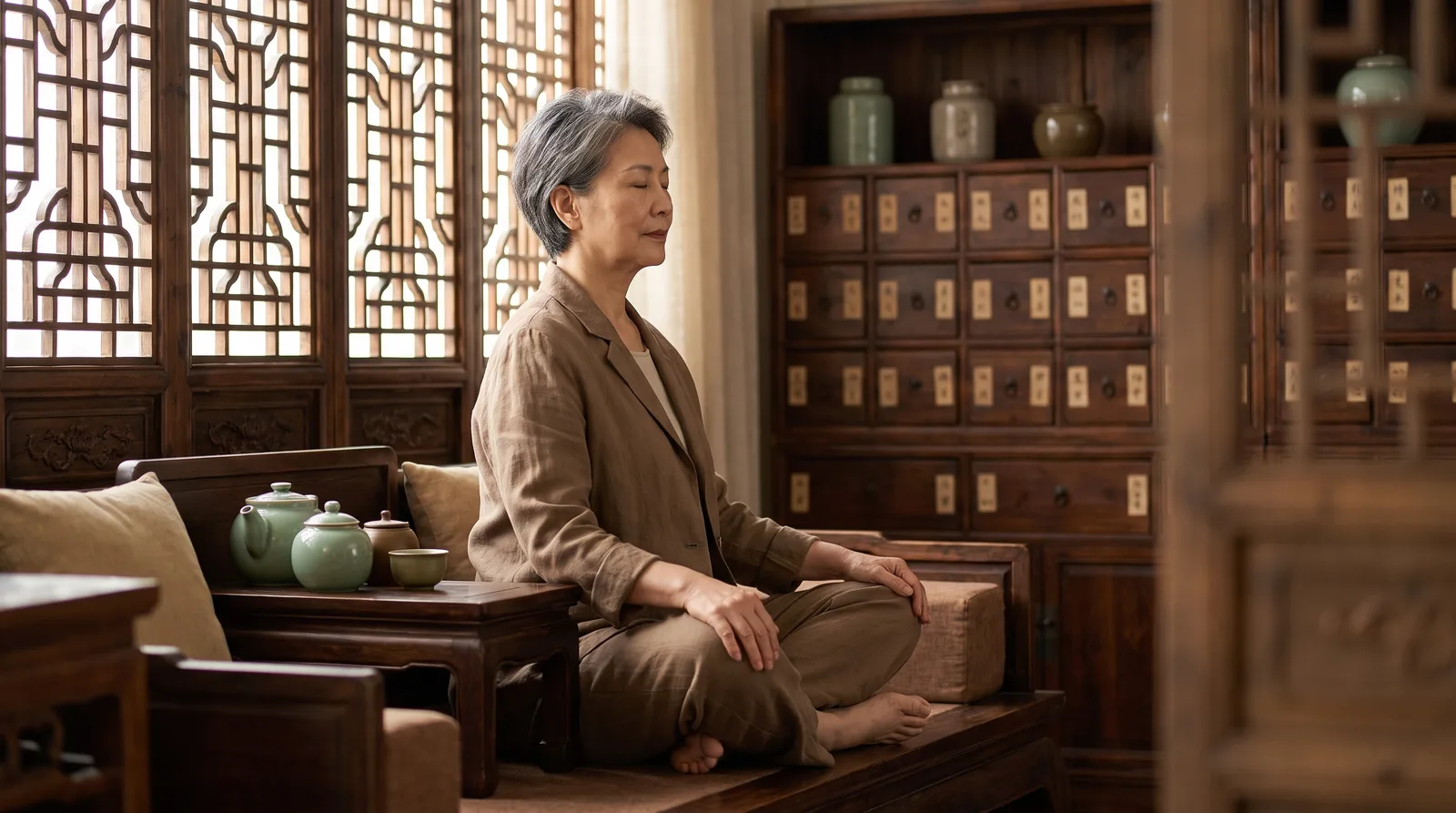
Two thousand years before the X-ray or the CT scan, China’s oldest medical classic, the Huangdi Neijing (the “Yellow Emperor’s Inner Classic”), was already doing something strikingly modern: reading how a person stands and slumps, and treating it as a report on what’s happening inside. And its verdict on a bent back was not gentle. “The residence is failing” (府將壞矣).
To an ancient Chinese doctor, a slouch was never a matter of etiquette. It was a warning light. This article starts with what those old texts said about the spine, and then asks how much of it modern research has since caught up to.
Chinese medicine read your posture as a diagnosis
One passage in the Huangdi Neijing calls several key body parts “residences” (府), the storehouses of the body’s vitality. And how does it judge whether a “residence” is failing? By your posture:
“The head is the residence of essence and brightness; when the head hangs and the gaze sinks, the spirit is being lost. The back is the residence of the chest; when the back bends and the shoulders slump, the residence is failing. The waist is the residence of the kidney; when it cannot turn, the kidney is exhausted. … The bones are the residence of the marrow; when one cannot stand for long and walks unsteadily, the bones are failing.” (素問·脈要精微論)
In plain terms: a drooping head and glazed eyes mean the spirit is draining away; a bent back and slumped shoulders mean the “residence” is breaking down; a waist that won’t turn signals decline. Without a single instrument, these doctors used your posture to read your inner state. It was the first report they knew how to read.
To Chinese medicine, the spine is the body’s main “energy highway”
And the spine wasn’t just scaffolding to them. Among the body’s channels, the Governor Vessel (督脈) runs straight up the middle of the back. The Classic of Difficult Issues describes it “running along the inside of the spine, up to the back of the head, and into the brain.” This channel was called the “sea of the yang meridians,” the master line governing the body’s yang energy.
In other words, this tradition placed the body’s single most important “energy highway” right inside your spine. An upright spine, in this theory, isn’t only about standing steady, it’s about keeping that highway open.
(To be clear up front: qi, meridians, and the Governor Vessel are traditional, functional concepts, not energy channels proven by modern anatomy. We’ll come back to that honestly.)
So what did the old doctors prescribe? Move, and stay upright
If a collapsed body was the illness, the remedy was simple: get the body moving, and keep it aligned. The famous physician Hua Tuo put it best (in the Records of the Three Kingdoms):
“The body wants exertion, only not to exhaustion. Movement disperses the grain-energy, the blood flows freely, and illness cannot arise, like a door-hinge that never rots … so as to delay ageing.”
His idea grew from an older line: “Running water does not go stale; a door-hinge does not get worm-eaten” (流水不腐,戶樞不蠹). On that basis he created the “Five Animal Frolics,” a set of exercises imitating the tiger, deer, bear, ape and bird, stretching the waist and spine, working the joints, all aimed at one thing: ageing slowly.
See the logic? Don’t let the body collapse, jam, and rust. Move it, and keep it straight.
Two thousand years on, which parts hold up?
We can’t put the ancients’ “qi” in a laboratory. But several of their observations about posture turn out to line up with modern findings.
“The bent back, the failing residence” → posture and lifespan. This is the most startling match. A prospective study following more than a thousand older adults found that those with a markedly hunched posture (medically, hyperkyphosis) had about a 1.4 times higher death rate (Kado et al., 2004). Two thousand years ago: “a bent back is a residence failing.” Two thousand years later: the people with the bent backs died sooner. (Honestly, though: that’s a structural curvature of old age, often tied to osteoporosis, an association, not proof that slouching at your desk will shorten your life.)
The “residence of the chest” → breathing. When you slump, you crush your rib cage and diaphragm. It’s been measured: in the same people, respiratory-muscle strength was clearly lower sitting slouched than sitting upright (Albarrati et al., 2018). The old name “residence of the chest” sits on top of some very concrete mechanics.
“The head hangs, the spirit is lost” → mood and focus. People held in an upright posture reported higher self-esteem and better mood than slumped ones (Nair et al., 2015); simply sitting up straight increased their confidence in their own thoughts (Briñol et al., 2009). The old claim that a hanging head “steals” the spirit points in the right direction.
The honest part: what’s real, and what’s tradition
We have to be straight with you. In Chinese medicine, qi, the meridians, the Governor Vessel, and the organs-as-”residences” are traditional, functional concepts, not things proven by modern anatomy or clinical trials. The “kidney” here is not the anatomical kidney on a scan, and “the residence is failing” is not a diagnosis you can act on.
What genuinely holds up is the observation wrapped inside that language: a body left collapsed, drooping, and jammed really does travel together with worse vitality, breathing, and mood, the ancients saw it, and modern research has measured it, piece by piece. But don’t run it backwards: a slouch does not mean an organ is failing. If something actually feels wrong, the answer is a doctor, not a blog post.
So how do you do it?
The good news: the old prescription still works, and it’s free. Don’t let the body collapse and rust. Set your head level and let the spine lengthen, as if a thread were lifting the crown of your head; then get up and move often. That’s the plain-language version of “a hinge that never rots.”
Right now, as you read this, straighten your back once.
The bottom line (and where we fit)
Two thousand years ago, Chinese medicine used four blunt characters, “the residence is failing”, to warn you that a collapsed body is not a small thing. Strip away the traditional language, and the observation underneath is solid: an upright body travels with better breathing, better mood, and maybe a better old age. The hard part, as always, is remembering to do it, especially slumped at a desk where your head drifts forward by the hour.
That’s the narrow job NeckCure does. It uses your webcam to notice when your head creeps forward and your spine caves, and nudges you back toward that tall, “well-oiled hinge” posture. It isn’t Chinese medicine, and it won’t diagnose any organ. It just helps you spend more time in the posture that a 2,000-year-old classic was already trying to warn you about.
(This is a popular article about the history of Chinese medicine and posture, not medical advice, and no substitute for a diagnosis from a doctor of Chinese or Western medicine. If you have back or neck pain or any other symptom, please consult a health professional.)
References
- Huangdi Neijing (黃帝內經), Suwen, 'Mai Yao Jing Wei Lun' (素問·脈要精微論) (-100). The Yellow Emperor's Inner Classic, Basic QuestionsFoundational classical Chinese medical text (Han dynasty compilation). SourceThe anchor passage. It calls the head, back, waist and bones the 'residences' (府) of the body's vitality, and reads a failing posture as organ decline: 'the back is the residence of the chest; when the back bends and the shoulders slump, the residence is failing' (背者胸中之府,背曲肩隨,府將壞矣).
- Nan Jing (難經, 'Classic of Difficult Issues'), 28th Difficulty (100). The Classic of Difficult IssuesClassical Chinese medical text. SourcePlaces the body's main yang channel (the Governor Vessel, 督脈) inside the spine: 'it runs along the inside of the spine, up to the back of the head, and enters the brain' (並於脊里,上至風府,入屬於腦). In this tradition the spine is the 'sea of the yang channels'. Note: meridians are a traditional concept, not validated anatomy.
- Chen Shou (陳壽), Records of the Three Kingdoms (三國志), Biography of Hua Tuo (290). Biography of the physician Hua Tuo (華佗傳)Classical Chinese history. SourceThe physician Hua Tuo's exercise prescription: 'the body wants exertion... movement disperses the grain-qi, the blood flows, and illness cannot arise, like a door-hinge that never rots' (動搖則穀氣得消,血脈流通,病不能生,譬猶戶樞終不朽也), the basis of his 'Five Animal Frolics'. Built on the older maxim 'running water does not rot' (流水不腐,戶樞不蠹).
- Kado DM, Huang MH, Karlamangla AS, Barrett-Connor E, Greendale GA (2004). Hyperkyphotic posture predicts mortality in older community-dwelling men and women: a prospective studyJournal of the American Geriatrics Society. PMID 15450042DOI 10.1111/j.1532-5415.2004.52458.xThe modern echo of '府將壞矣'. Older adults with a markedly hunched (hyperkyphotic) posture had about a 1.4x higher mortality rate. Caveat: a structural curvature of old age, often tied to osteoporosis/fractures, an association, not proof that desk-slouching shortens life.
- Albarrati A, Zafar H, Alghadir AH, Anwer S (2018). Effect of upright and slouched sitting postures on the respiratory muscle strength in healthy young malesBioMed Research International. PMID 29682532DOI 10.1155/2018/3058970For the 'chest residence' / breathing point. Respiratory-muscle strength was measurably lower slouched than upright; slumping cramps the diaphragm.
- Nair S, Sagar M, Sollers J 3rd, Consedine N, Broadbent E (2015). Do slumped and upright postures affect stress responses? A randomized trialHealth Psychology. PMID 25222091For the 'spirit' point (頭傾視深,精神將奪). People held upright reported higher self-esteem, better mood and less fear than slumped participants.
- Briñol P, Petty RE, Wagner B (2009). Body posture effects on self-evaluation: a self-validation approachEuropean Journal of Social Psychology. DOI 10.1002/ejsp.607Sitting upright increased the confidence people placed in their own thoughts, versus a slumped posture.