Sexual Health
Your slouch could be quietly stealing your sex life
Nobody blames their posture for a bad sex life, and no study says fixing it will save one. But two well-evidenced chains quietly connect the slump at your desk to what happens in bed. Here's the honest, slightly awkward version.
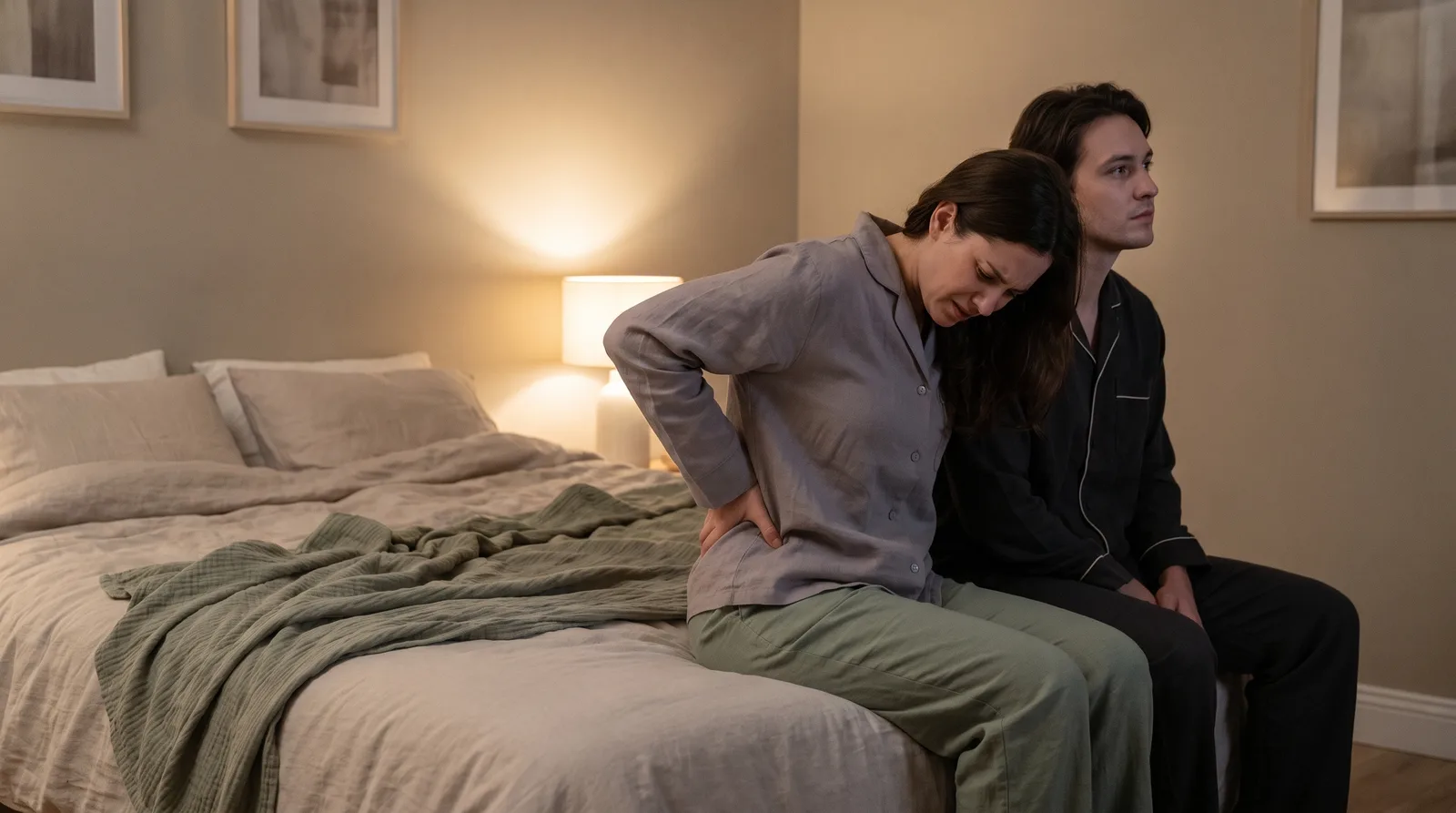
Make a list of things that could be dragging down your sex life. Stress. Bad sleep. The state of the relationship. Hormones. That third glass of wine. Almost nobody writes down “the way I sit.” And to be fair, there is no study showing that fixing your posture will fix your sex life. But there are two well-evidenced chains that quietly connect the slump at your desk to what happens, or doesn’t, in your bedroom. Once you see them, they’re hard to unsee.
Chain one: the pain you build at your desk follows you to bed
Start with something uncomfortable and very well documented. Chronic back pain and sex do not get along. In a study of 702 people with chronic low back pain versus 888 without, sexual problems showed up in 71.1% of the women with back pain, against 36.8% of those without, and erectile dysfunction hit 59.5% of the men with back pain, versus 24.5% without (Nikoobakht et al., 2014). A separate study found 81% of chronic-back-pain patients reported sexual difficulties tied directly to their pain, most often painful positioning during sex (Bahouq et al., 2013).
Pain is a mood-killer, a movement-limiter, and a distraction, all at the same moment. And a large share of the neck and back pain people carry is the kind they build slowly, hunched at a desk, day after day. That ache doesn’t clock out when you do. It comes home with you.
Chain two: a collapsed body carries a collapsed confidence
The second chain runs through your head. How you feel in your body is not a minor factor in bed, it’s one of the biggest. Research consistently finds that body image and self-consciousness during intimacy strongly shape sexual satisfaction: the more preoccupied and self-conscious people feel about their bodies during sex, the less satisfied they tend to be (van den Brink & Vollmann, 2022).
And here’s the link most people skip over: posture feeds straight into how you feel about your body. Taped into an upright posture, people report higher self-esteem, a better mood, and more confidence in their own thoughts (Nair et al., 2015; Briñol et al., 2009). A body that spends all day collapsed, tense, and braced doesn’t just look closed off. It starts to feel that way, and it carries that feeling into the bedroom with it.
The honest part (read this one slowly)
Time to be straight, because this is exactly the kind of topic the internet turns into snake oil. There is no study showing that sitting up straighter improves erections, libido, or orgasms. The connections above are real but indirect: posture to pain to sex, and posture to confidence to sex. Nobody has shown a direct posture-to-sex effect, and we’re not going to pretend anyone has.
And please ignore anyone selling “power poses raise your testosterone.” That famous claim collapsed under a large replication that found no hormonal effect at all, just a self-reported feeling of power (Ranehill et al., 2015), and even the original author walked it back. Your posture is not a testosterone dial.
When to see a doctor (this matters more than your posture)
Some sexual problems are medical, and one of them is a genuine warning light. Erectile dysfunction can be an early sign of cardiovascular disease, sometimes showing up years before any heart trouble does, so new or persistent ED deserves a doctor, not a stretching routine. Also get seen for: pain during sex; a sudden drop in libido alongside fatigue or mood changes (thyroid problems, depression, and medications are common culprits); or any sexual difficulty that is persistent or distressing. Posture is a lifestyle lever. It is not a treatment, and it is never a substitute for ruling out the medical causes.
The bottom line (and where we fit)
So no, straightening your spine is not a bedroom hack, and we’d never insult you by pretending it is. But look at what both chains share at the very top: a body that spends all day collapsed forward at a desk, quietly stacking up the ache and the closed-off, low-confidence posture that neither chain is helped by. That daily slump is the shared upstream cause. And it happens to be the one part of this whole picture you can straightforwardly adjust.
That’s the small, honest job NeckCure does. It uses your webcam to catch the forward-head, hunched-chest slump while you work, and nudges you upright before it becomes the only shape your body remembers. It will not fix your sex life, treat a medical problem, or replace a doctor, and if anything above rang a bell, please go see one. What it does is take the daily load off the single upstream habit that feeds both chains, which is a quietly worthwhile thing to have in your own hands.
References
- Nikoobakht M, Fraidouni N, Yaghoubidoust M, Burri A, Pakpour AH (2014). Sexual function and associated factors in Iranian patients with chronic low back painSpinal Cord. PMID 24322217DOI 10.1038/sc.2013.151In 702 people with chronic low back pain versus 888 without, sexual problems affected 71.1% of women with back pain (vs 36.8% without) and erectile dysfunction affected 59.5% of men (vs 24.5%). Chronic back pain and sex do not coexist happily.
- Bahouq H, Fadoua A, Hanan R, Ihsane H, Najia HH (2013). Profile of sexuality in Moroccan chronic low back pain patientsBMC Musculoskeletal Disorders. PMID 23413914DOI 10.1186/1471-2474-14-63Corroboration: 81% of chronic-back-pain patients reported sexual difficulties tied to their pain, most commonly painful positioning during intercourse. Pain is a movement limiter and a distraction at once.
- van den Brink F, Vollmann M (2022). Young women's sexual satisfaction in danger: the significance of thin-ideal internalization, positive body image, and appearance-related self-consciousness during physical intimacyHealth Psychology Report. PMID 38084349DOI 10.5114/hpr/153967Body image and appearance-related self-consciousness during intimacy strongly shape sexual satisfaction: feeling preoccupied and self-conscious about your body during sex predicts lower satisfaction.
- Nair S, Sagar M, Sollers J 3rd, Consedine N, Broadbent E (2015). Do slumped and upright postures affect stress responses? A randomized trialHealth Psychology. PMID 25222091People randomly taped into an upright posture reported higher self-esteem, better mood and less fear than slumped participants. The link from posture to how you feel in your own body.
- Briñol P, Petty RE, Wagner B (2009). Body posture effects on self-evaluation: a self-validation approachEuropean Journal of Social Psychology. DOI 10.1002/ejsp.607An upright, confident posture increased the confidence people placed in their own self-related thoughts, versus a slumped posture.
- Ranehill E, Dreber A, Johannesson M, Leiberg S, Sul S, Weber RA (2015). Assessing the robustness of power posing: no effect on hormones and risk tolerance in a large sample of men and womenPsychological Science. DOI 10.1177/0956797614553946The honesty check. A large replication found 'power posing' did NOT change testosterone or cortisol, only self-reported feelings of power. Your posture is not a testosterone dial; ignore anyone who says it is.