Martial Arts
Why ancient Chinese martial arts make you straighten up first, and what you actually get for it
From Tai Chi to Shaolin kung fu, almost every Chinese martial art's first lesson is the same: straighten your spine. And the old masters claimed it buys you real things, sharper focus, more power, even a longer life. Which parts are true? Here's an upright spine's payoff, checked one claim at a time against modern research.
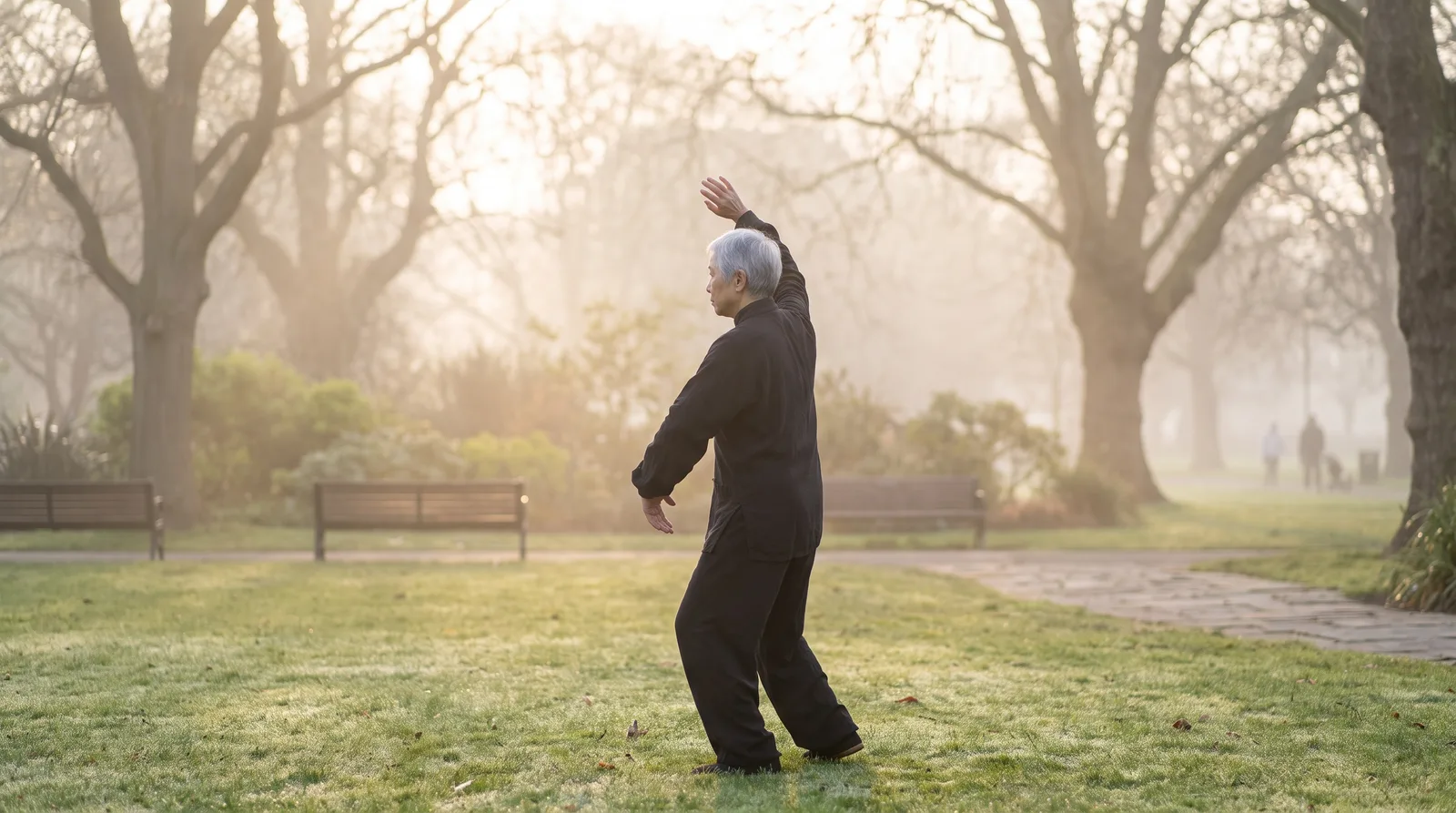
Picture the calm master in every kung fu film: perfectly still, perfectly upright, radiating a quiet authority before a single move is thrown. For centuries, almost every Chinese martial art, from the slow-flowing Tai Chi you’ve seen in parks to hard Shaolin kung fu, has drilled the same lesson before any punch or kick: keep your spine long, vertical, and centred.
And they didn’t just tell you to straighten up. They made big promises about what it buys you: your spirit “lifts,” power flows out of your spine, you even live longer. It sounds like old-master mysticism. But strip away the mystique, pull each claim out on its own, and check it against modern research, and you find something surprising: an upright spine pays off more than you’d think.
The martial arts are just the hook here. The real subject is what standing up straight actually gets you.
First, how the traditions see it. They gave “standing straight” a name: central equilibrium (中正). Don’t collapse forward or lean to one side; stack the spine tall, head balanced on top. The Tai Chi classic Song of the Thirteen Postures puts it as “tailbone centred, the spirit reaches the crown; the whole body light, the head as if suspended.” When a master listed the ten most important rules of the art in 1925, number one wasn’t a strike, it was “empty, lively energy at the crown” (虛靈頂勁): head upright, spine long. Different lineages, different centuries, people who never met, all landing on the same instruction. So what did they say you’d get for it? Let’s take the claims one at a time.
Benefit 1: your spirit “lifts” (mood and confidence)
The masters put this one first. Explaining “energy at the crown,” Yang Chengfu says flatly that without it, “the spirit cannot be roused” (精神不能提起): head up and suspended, you feel alert; head dropped and neck scrunched, you wilt.
That sounds subjective, and yet it’s exactly the kind of thing modern research can measure. In a randomised trial, people held in an upright posture reported higher self-esteem, better mood, and less fear under stress than slumped participants (Nair et al., 2015). In another, simply sitting up straight increased how much confidence people placed in their own thoughts (Briñol et al., 2009).
In other words, “lifting the spirit” wasn’t just poetry. How you hold your body really does loop back and change how you feel inside it.
Benefit 2: more presence, more visible to others
Back to that master: he hasn’t moved, so where does the quiet authority come from? The tradition calls it standing “centred and at ease, supported on all eight sides” (Wu Yuxiang), stand straight and stable enough, and you simply occupy your space.
There’s a modern version of that too. Researchers filmed real speed-dates and found the strongest predictor of getting a “yes” wasn’t looks, it was an open, space-taking posture — each step up in openness nearly doubled the odds of a yes (Vacharkulksemsuk et al., 2016). A slouch is the opposite: folding in, making yourself small. Before anyone has said hello, your posture has already spoken for you. (We dig into this one in a separate piece on posture and attraction.)
Benefit 3: easier, stronger breathing
Tai Chi talks about “sinking the qi to the dantian” and keeping “qi and blood flowing.” Set the mysticism of the word qi aside, and there’s something very concrete underneath: when you slump, you crush your diaphragm and rib cage.
It’s been measured. In the same group of people, respiratory-muscle strength was clearly lower sitting slouched than sitting upright (Albarrati et al., 2018). Collapsing forward jams the very muscle that pulls air in. This isn’t about believing in energy flow, it’s plain mechanics: a straight spine opens the chest, and a full breath follows.
Benefit 4: maybe, ageing a little slower
The Song of the Thirteen Postures ends by asking what all of this is finally for, and reaches high: “to prolong life and delay ageing, an ageless spring” (益壽延年不老春). The old masters connected an upright body all the way to longevity.
This is the claim most likely to get oversold, so we’ll go carefully, but it, too, has a thread of modern research behind it. A prospective study following more than a thousand older adults found that those with a markedly hunched posture (medically, hyperkyphosis) had about a 1.4 times higher death rate (Kado et al., 2004).
To be clear, so this isn’t misread: that’s a structural curvature of old age, often linked to osteoporosis and spinal fractures, and it’s an association, not proven cause. It does not mean “slouching at your desk will shorten your life.” But it’s a real reminder that a body left collapsed for decades isn’t a small thing later on.
The honest part: what’s real, and what’s just tradition
We should be straight with you, because these traditions come wrapped in exotic-sounding ideas: qi (a traditional notion of “vital energy”), the dantian (a point below the navel), meridians. Those are cultural and philosophical concepts, not proven anatomy or medicine. Standing straight won’t channel mysterious energy, grant you superpowers, or cure disease.
And not every martial claim holds up. “Power issues from the spine, matchless” (力由脊發,所向無敵)? A straight spine does transmit force better, which matters in training, but no, modern science has not shown that good posture makes you unbeatable. Don’t take that one literally.
(While we’re here: the story that a monk named Bodhidharma carried the Yijinjing exercise set from India? A later legend. Historians date the actual text to the Ming dynasty. The exercise is real; the origin story is marketing.)
What’s genuinely striking is what’s left once the mysticism is gone: dozens of independent Chinese traditions, across centuries, converged on one plain instruction, don’t slump forward, and several of the payoffs they promised (mood, presence, breathing) turn out to have real modern evidence behind them.
So how do you actually do it?
You don’t need to learn Tai Chi, or believe a word about qi, to borrow the single most useful cue in all of it: “the head suspended” (頂頭懸). Imagine a thread tied to the crown of your head, gently lifting you toward the ceiling. Your spine hangs long beneath it, your chin settles back, your shoulders drop.
Try it right now, while you’re reading. It’s a 300-year-old cue, and it’s still the fastest posture reset there is.
The bottom line (and where we fit)
The payoffs are real: better mood and confidence, more presence, easier breathing, and maybe a better old age. It’s free, and it takes one second. The hard part is the same one the masters spent years solving: remembering to do it, especially slumped at a desk where your head drifts forward by the hour.
That’s the narrow job NeckCure does. It uses your webcam to notice when your head creeps forward and your spine caves, and nudges you back toward that tall, “string-from-the-crown” posture the old manuals were describing all along. It won’t make you a kung fu master. It just keeps you in that upright posture more often, the one every master for centuries told every beginner to find first, so you can quietly pocket the benefits above.
(This is an article about exercise philosophy, history, and posture, not medical advice. If you have back or neck pain or a diagnosed spinal condition, check with a health professional before starting any new practice.)
References
- Wang Zongyue (王宗岳) (1867). Treatise on Taijiquan (太極拳論)Classical Tai Chi text, Qing dynasty. SourceThe foundational Tai Chi text. Its posture rule: 'no leaning, no tilting' (不偏不倚) and 'an intangible energy lifts the crown of the head' (虛領頂勁). Attribution to Wang Zongyue is traditional; the text surfaced in a 19th-century manual.
- Attributed to Wang Zongyue (王宗岳) (1867). Song of the Thirteen Postures (十三勢歌)Classical Tai Chi verse, Qing dynasty. SourceSource of 'tailbone centered, spirit to the crown; the whole body light, the head as if suspended' (尾閭中正神貫頂,滿身輕利頂頭懸), and of the closing claim that the ultimate purpose is 'to prolong life and delay ageing' (益壽延年不老春).
- Wu Yuxiang (武禹襄) (1867). Mental Elucidation of the Thirteen Postures (十三勢行功心解)Classical Tai Chi text, Qing dynasty. SourceGives 'stand centered and at ease, supported on all eight sides' (立身須中正安舒,支撐八面) — the clearest classical statement of central equilibrium and stable presence.
- Yang Chengfu (楊澄甫), recorded by Chen Weiming (陳微明) (1925). The Ten Essentials of Taijiquan (太極拳術十要)Republican-era Tai Chi manual. SourceThe systematic list of body rules. It claims specific payoffs of an upright spine: without 'energy at the crown' (虛靈頂勁) 'the spirit cannot be roused' (精神不能提起); a raised back means 'power issues from the spine' (力由脊發); a loose waist gives 'both feet strength, a solid base' (兩足有力,下盤穩固).
- Attributed (apocryphally) to Bodhidharma; text dated to the Ming dynasty (1624). Yijinjing (易筋經, 'Muscle-Tendon Change Classic')Ming-dynasty exercise manual. SourceA tendon-changing exercise set built around an erect spine. The popular 'Bodhidharma brought it from India' origin is a later legend; historian Tang Hao dated the text to the Ming. Real practice, invented backstory.
- Nair S, Sagar M, Sollers J 3rd, Consedine N, Broadbent E (2015). Do slumped and upright postures affect stress responses? A randomized trialHealth Psychology. PMID 25222091Benefit 1 (mood/spirit). People randomly held upright reported higher self-esteem, better mood and less fear under stress than slumped participants.
- Briñol P, Petty RE, Wagner B (2009). Body posture effects on self-evaluation: a self-validation approachEuropean Journal of Social Psychology. DOI 10.1002/ejsp.607Benefit 1 (confidence). Sitting upright increased the confidence people placed in their own thoughts, versus a slumped posture.
- Vacharkulksemsuk T, Reit E, Khambatta P, Kern ML, Eastwick PW, Finkel EJ (2016). Dominant, open nonverbal displays are attractive at zero-acquaintanceProceedings of the National Academy of Sciences (PNAS). DOI 10.1073/pnas.1508932113Benefit 2 (presence). In real speed-dates, an open, space-taking posture was the strongest nonverbal predictor of attraction; each step up nearly doubled the odds of a 'yes'.
- Albarrati A, Zafar H, Alghadir AH, Anwer S (2018). Effect of upright and slouched sitting postures on the respiratory muscle strength in healthy young malesBioMed Research International. PMID 29682532DOI 10.1155/2018/3058970Benefit 3 (breathing). Respiratory muscle strength (sniff nasal inspiratory pressure) was measurably lower in slouched than in upright sitting; slumping cramps the diaphragm.
- Kado DM, Huang MH, Karlamangla AS, Barrett-Connor E, Greendale GA (2004). Hyperkyphotic posture predicts mortality in older community-dwelling men and women: a prospective studyJournal of the American Geriatrics Society. PMID 15450042DOI 10.1111/j.1532-5415.2004.52458.xBenefit 4 (ageing), with caveats. Older adults with a markedly hunched (hyperkyphotic) posture had about a 1.4x higher mortality rate. Note: this is a structural curvature of old age, often tied to osteoporosis/fractures, not proof that desk-slouching shortens life.