Alexander Technique
The actor who kept losing his voice, and the posture method that actually holds up in trials
A stage actor kept mysteriously going hoarse. Standing in front of mirrors, he traced it to the way he yanked his head back and down, and built a whole method around freeing the neck and letting the spine lengthen. Unlike most posture traditions, this one has been through real randomized trials for back and neck pain. Here's what the evidence actually shows.
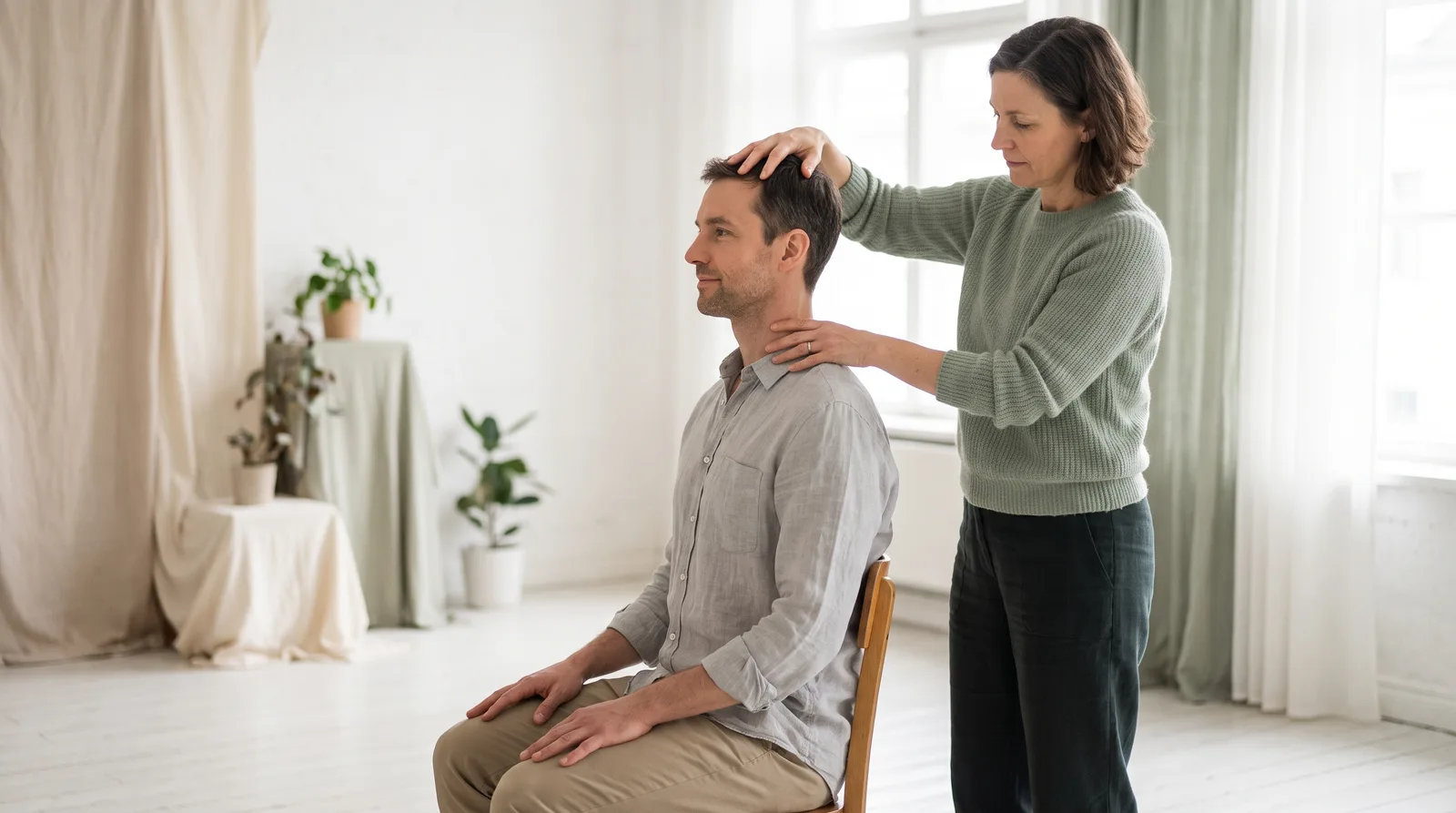
Sometime in the 1890s, a young Australian actor named Frederick Matthias Alexander had a problem that was quietly ending his career: on stage, in the middle of a performance, his voice would give out. Doctors found nothing wrong. Rest helped, and then the hoarseness came back the moment he was reciting again. So Alexander did something stubborn and slightly strange. He set up mirrors around himself and watched, closely, what his own body did the instant he began to speak.
What he saw was a habit he’d never noticed. Every time he started to project his voice, he pulled his head back and down, stiffened his neck, and shortened his whole spine. It was so automatic he couldn’t feel it happening, and it was throttling him. The rest of his life became an investigation into how to stop doing it, and out of that came the Alexander Technique: not an exercise, not a stretch, but a method of un-learning the tension you carry without realizing it.
Alexander’s central idea has an unglamorous name: primary control. The claim is simple. The relationship between your head, your neck, and your back sets the tone for how your whole body coordinates. Get that relationship free and easy, and everything downstream moves better. Jam it, the way Alexander jammed his by hauling his head back and down, and you drag the rest of your body out of shape with it. So the technique teaches one governing cue: let the neck be free, let the head go “forward and up,” and let the spine lengthen. A trained teacher guides you into it, hands-on, over a series of lessons, until you can find it yourself.
That’s the method in a paragraph. Here’s the part that matters more, and the reason this article is different from the others in this series.
Why this one is different: it went through real trials
Most posture traditions are old, wise, and completely untested. The Alexander Technique is unusual because someone actually ran it through randomized controlled trials, the same kind of study used to test medicines. That’s rare for anything in this corner of health, and it’s the whole reason to take it seriously. Let’s look at what those trials found.
Benefit 1: less back pain, and it lasted
The headline study is the ATEAM trial (Little et al., 2008), published in the BMJ. Researchers took 579 people with chronic or recurrent low back pain, the stubborn, keeps-coming-back kind, and randomly assigned them to different treatments. The group that received a course of 24 one-to-one Alexander Technique lessons saw significant reductions in pain and, importantly, in disability, how much the back was actually stopping them living, and those improvements were still there a year later.
There was even a budget option in the data: six lessons plus a course of prescribed exercise (mostly walking) delivered much of the same benefit. So the effect wasn’t just “pay for two dozen sessions or nothing.” But make no mistake, this was hands-on re-education, not a pill and not a one-off.
Benefit 2: less neck pain, measured against usual care
The second big trial targeted the neck, which is where so many of us hurt now, hunched over phones and laptops. MacPherson et al., 2015, in the Annals of Internal Medicine, followed 517 people with chronic neck pain. After 12 months, the group taking Alexander Technique lessons had neck pain down about 31%, compared with about 23% for people getting usual care.
Sit with that gap for a second. It’s real, and it points the right way, but it’s a difference of several percentage points over a year, not a switch that turns pain off. Which is exactly the honest shape of this whole story, and we’ll come back to it.
Benefit 3 and 4: the everyday posture payoffs
Beyond the pain trials, uprightness itself carries perks that show up in other research, and the Alexander Technique is, at heart, about getting and keeping you upright.
One is mood. In a randomized trial, people held in an upright posture reported higher self-esteem, better mood, and less fear than slumped participants (Nair et al., 2015). How you carry your body loops back and nudges how you feel inside it.
The other is breathing. When you collapse forward, you crush the very muscles that pull air in. Measured directly, respiratory-muscle strength was lower in slouched sitting than in upright sitting (Albarrati et al., 2018). A long spine opens the chest; a full breath follows.
The honest part
Now the firewall, because this method attracts overclaiming and it deserves better than that.
The trials show a benefit that is real but modest, and gradual, not a cure, not a miracle. Nobody walked out of a lesson fixed. It takes multiple one-to-one lessons and steady practice to change a habit you’ve spent decades building, and it costs time and money to do properly.
“Primary control”, the head-neck-back idea at the center of it all, is the method’s own concept, not a proven physiological mechanism. It’s a useful organizing principle and a good instruction; it is not established anatomy. And while the evidence here is genuinely good for this kind of thing, the overall base is smaller than for mainstream back-pain treatments. Fewer trials, fewer patients. Promising, not settled.
None of that makes it a gimmick. It makes it what it is: a hands-on retraining that helps some people meaningfully, slowly, with effort.
A taste of the cue
You can’t learn the technique from a paragraph, that’s the point of the teacher and the lessons. But you can sample the idea. Right now, wherever you’re sitting, stop doing anything to your posture and instead let your neck be free. Don’t yank your head up; let it release forward and up, as if it’s floating off the top of your spine. Feel the length that opens down your back. Then notice how quickly the old habit, chin poking forward, neck gripping, tries to creep back. That noticing is the whole practice in miniature.
The bottom line (and where we fit)
NeckCure is not the Alexander Technique, and it is no substitute for lessons with a trained teacher. What it shares is the exact target Alexander spotted in his mirrors more than a century ago: the head drifting forward and down, the neck gripping, the spine caving. NeckCure uses your webcam to catch that habit as it happens and nudge you back tall.
That’s a narrow job, and we’ll be honest about the limit: an app can remind you, but it can’t put its hands on your neck or teach you the deeper skill a real teacher can. If your pain is persistent, the trials point toward lessons, not just a nudge on your screen.
(This is an article about posture, history, and research, not medical advice. If you have ongoing back or neck pain or a diagnosed spinal condition, please see a qualified health professional before starting any new practice.)
References
- Alexander FM (Frederick Matthias Alexander), the Alexander Technique. The Alexander Technique and the concept of 'primary control'Posture re-education method (late 19th to early 20th century). SourceAlexander (1869-1955), an actor who lost his voice, developed a method of posture re-education. Its central idea, 'primary control', is that the head-neck-back relationship governs overall coordination; the cue is to free the neck and let the head go 'forward and up' so the spine lengthens.
- Little P, Lewith G, Webley F, Evans M, Beattie A, Middleton K, et al. (2008). Randomised controlled trial of Alexander technique lessons, exercise, and massage (ATEAM) for chronic and recurrent back painBMJ. PMID 18713809DOI 10.1136/bmj.a884The back-pain evidence. In 579 patients, 24 one-to-one Alexander Technique lessons produced significant, lasting reductions in back pain and disability; six lessons plus prescribed exercise also helped.
- MacPherson H, Tilbrook H, Richmond S, Woodman J, Ballard K, Atkin K, et al. (2015). Alexander technique lessons or acupuncture sessions for persons with chronic neck pain: a randomized trialAnnals of Internal Medicine. PMID 26524571DOI 10.7326/M15-0667The neck-pain evidence. In 517 patients, neck pain fell about 31% at 12 months with Alexander Technique lessons versus about 23% with usual care.
- Nair S, Sagar M, Sollers J 3rd, Consedine N, Broadbent E (2015). Do slumped and upright postures affect stress responses? A randomized trialHealth Psychology. PMID 25222091The mood payoff. People held upright reported higher self-esteem, better mood and less fear than slumped participants.
- Albarrati A, Zafar H, Alghadir AH, Anwer S (2018). Effect of upright and slouched sitting postures on the respiratory muscle strength in healthy young malesBioMed Research International. PMID 29682532DOI 10.1155/2018/3058970The breathing payoff. Respiratory-muscle strength was measurably lower slouched than upright.